Most drivers think their car failed suddenly. In reality almost every major breakdown is the result of small mistakes repeated over months or years — each one adding a little more damage until something finally gives way. Understanding these habits is the single most effective thing you can do to extend your car's life and avoid expensive repairs.
Maintenance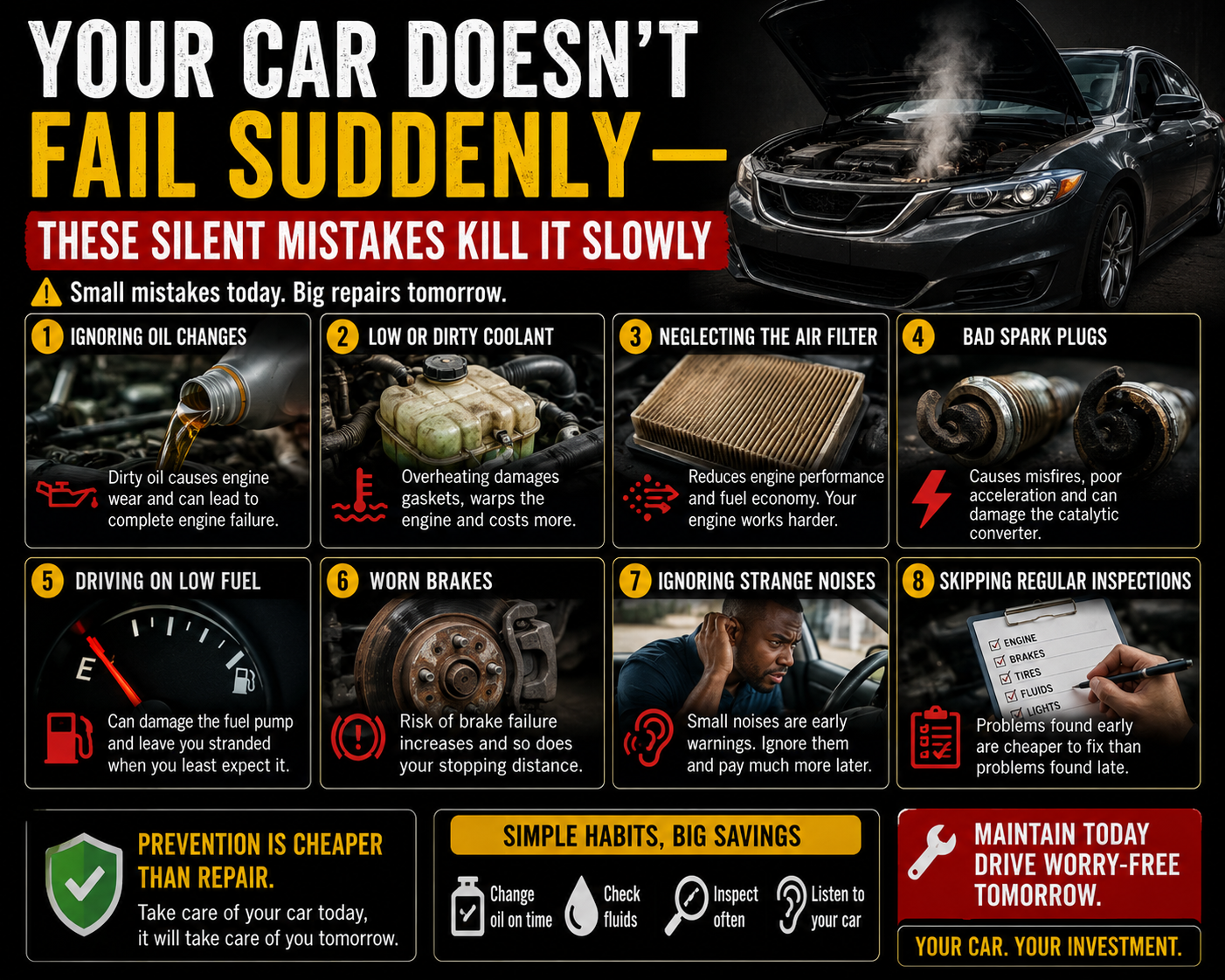
Maintenance
Your Car Doesn't Fail Suddenly — These Silent Mistakes Kill It Slowly
February 5, 2026 6 min readMaintenance
Vehicles fail slowly from small mistakes drivers make and ignore every day. Here's what's quietly wearing your car out.
Written by
Car Guide CrewThe Car Guide Crew editorial team publishes practical, mechanic-verified automotive knowledge — helping drivers understand, diagnose, and maintain their vehicles.
DiagnosticsEngine SystemsMaintenanceElectrical Systems
Published: Feb 5, 2026
1. Ignoring Dashboard Warning Lights
Dashboard warning lights are not suggestions — they are early alerts designed to warn you while the problem is still small and cheap to fix. Every week you drive with a warning light on, the underlying problem gets worse and more expensive.
The most dangerous lights to ignore:
- Oil pressure light — engine damage begins within seconds of oil pressure loss
- Temperature warning — overheating destroys head gaskets and warps cylinder heads
- Check engine light flashing — active misfire is destroying your catalytic converter in real time
- Battery warning — driving on a failing alternator will leave you stranded
A solid check engine light means diagnose soon. A flashing check engine light means stop driving now. This single distinction saves drivers thousands in catalytic converter repairs every year.
2. Skipping or Delaying Oil Changes
Engine oil does three critical jobs — it lubricates moving parts, it cools components the coolant cannot reach, and it cleans the engine by suspending contaminants. As oil ages it breaks down, loses its viscosity, and accumulates metal particles and combustion byproducts.
Old dirty oil causes:
- Sludge buildup inside the engine blocking oil passages
- Accelerated bearing wear from contaminated oil
- Increased engine temperatures from reduced cooling
- Stuck hydraulic lifters producing ticking noises
- Timing chain stretch from inadequate lubrication
Engine sludge from chronic oil change neglect is one of the most expensive repairs a mechanic sees. Once sludge blocks oil passages the engine requires either a complete teardown and cleaning or full replacement. A $60 oil change ignored becomes a $5,000 engine repair.
3. Running the Engine Low on Coolant
Coolant does not just prevent freezing — it prevents overheating and protects the entire cooling system from corrosion. Running low on coolant — even slightly — raises engine operating temperature.
The chain reaction of low coolant:
- Engine runs hotter than designed
- Head gasket begins to fail under thermal stress
- Cylinder head warps from uneven heating
- Coolant enters combustion chamber — white smoke from exhaust
- Complete head gasket failure — $1,500 to $3,500 repair
4. Ignoring Brake Wear
Brake pads have a wear indicator — a small metal tab that contacts the rotor and squeals when pads are near the end of their life. Most drivers hear this squeal and ignore it for weeks. Once the pad wears through completely the metal backing plate grinds against the rotor, destroying it.
| Stage | Sound | Repair Needed | Cost |
|---|---|---|---|
| Wear indicator contact | Squealing | Pads only | $100–$250 |
| Pad worn through | Grinding | Pads and rotors | $250–$600 |
| Rotor deeply grooved | Heavy grinding and vibration | Pads, rotors, calipers | $500–$1,200 |
5. Ignoring Tyre Pressure and Wheel Alignment
Low tyre pressure forces the tyre to flex more with each rotation, generating heat and accelerating tread wear. Misaligned wheels pull against each other constantly, wearing tyres unevenly and putting stress on suspension components.
What chronic low pressure and misalignment costs:
- Tyres wear out 30-50% faster than normal
- Fuel economy drops 2-3% per tyre underinflated by 10 PSI
- Ball joints, tie rod ends, and wheel bearings wear prematurely
- Steering and handling become imprecise and unsafe
Check tyre pressure monthly — not just when a tyre looks flat. A tyre can lose 25% of its pressure before it looks visibly low to the eye. Most petrol stations have free air. Correct pressure is on the sticker inside your driver door jamb — not on the tyre sidewall.
6. Using the Wrong Engine Oil Grade
Engine oil viscosity — the 5W-30 or 10W-40 on the label — is not a suggestion. It is an engineering specification matched to the clearances between moving parts in your specific engine. Using the wrong viscosity causes either too much or too little oil pressure at operating temperature.
- Too thick — engine works harder on cold starts, wears faster in cold weather
- Too thin — insufficient film strength at high temperatures, accelerated bearing wear
7. Riding the Brakes Downhill
Keeping constant light pressure on the brake pedal while descending a long hill generates sustained heat in the brake rotors and pads. Unlike a single hard stop which generates brief intense heat, sustained light braking bakes heat into the rotor continuously — causing warping and glazing of the brake pads.
The correct technique on long descents is engine braking — shifting to a lower gear and letting the engine slow the vehicle — with brief firm brake applications as needed instead of constant light pressure.
8. Ignoring Small Fluid Leaks
A small oil spot under the car, a slight power steering fluid seep, a minor coolant drip — these feel too small to worry about. In every case they get worse over time. Seals dry out further, gaskets deteriorate, and what started as a weep becomes a full leak that leaves you stranded.
The Real Cost of These Habits
| Ignored Habit | Small Fix | Result If Ignored | Eventual Cost |
|---|---|---|---|
| Oil changes overdue | $60 oil change | Engine sludge and seizure | $4,000–$8,000 |
| Brake squeal ignored | $150 pad replacement | Rotor and caliper damage | $600–$1,200 |
| Coolant low | $20 top up | Blown head gasket | $1,500–$3,500 |
| Tyre pressure ignored | Free air check | Premature tyre replacement | $400–$800 |
| Small oil leak ignored | $100–$300 seal repair | Engine runs dry | $4,000–$8,000 |
| Warning light ignored | $50–$200 diagnosis | Catalytic converter failure | $800–$2,500 |
Simple Habits That Prevent All of This
- Check engine oil level and condition every month
- Check tyre pressure monthly — takes 5 minutes
- Never ignore a warning light for more than one day
- Address brake noise immediately when it starts
- Fix small leaks before they become large ones
- Follow your manufacturer's service schedule — it exists for a reason
FAQ
How often should I check my oil? Once a month as a minimum. High mileage engines can consume oil between services — do not assume it is fine just because you recently had a service.
Is it okay to top up oil instead of doing a full change? Topping up is fine between changes but it does not replace a full oil and filter service. Old oil still contains contaminants and degraded additives regardless of level.
How do I know if my tyres are properly inflated? Check the sticker on the inside of your driver door jamb for the correct PSI. Use a tyre pressure gauge — do not judge by eye.
My car seems fine even though I skip services — is it really a problem? Yes. Engine wear from poor maintenance is cumulative and invisible until it reaches a threshold. By the time symptoms appear significant internal damage has already occurred.