Every time your engine fires, it needs a precise mixture of air and fuel to produce power. The fuel side of that equation gets a lot of attention — but the air side is equally critical. Your car's air intake system is responsible for delivering clean, correctly measured air to the engine in the exact volume and temperature the ECU demands. When any part of this system is blocked, leaking, or failing, the engine cannot breathe properly — and an engine that cannot breathe loses power, burns more fuel, and wears faster.
Engine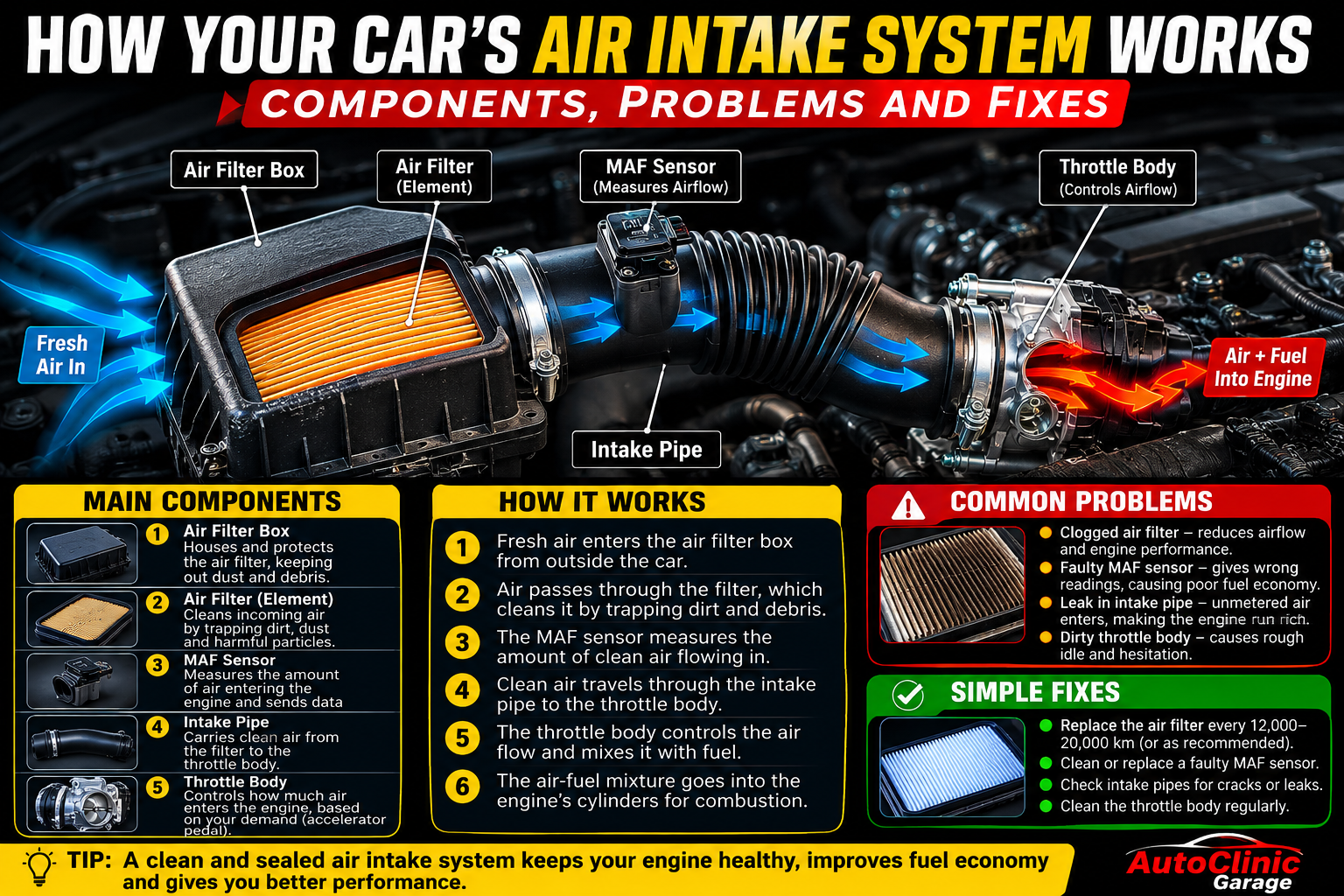
Engine
How Your Car's Air Intake System Works — Components, Problems and Fixes
August 26, 2026 5 min readEngine
Your engine needs clean measured air to run efficiently. Here is how every part of the air intake system works and what happens when any one of them fails.
Written by
Car Guide CrewThe Car Guide Crew editorial team publishes practical, mechanic-verified automotive knowledge — helping drivers understand, diagnose, and maintain their vehicles.
DiagnosticsEngine SystemsMaintenanceElectrical Systems
Published: Aug 26, 2026
How the Air Intake System Works
Air enters the intake system from outside the engine bay — usually through a scoop or opening at the front of the car. From there it passes through a series of components that clean it, measure it, regulate it, and distribute it evenly to every cylinder. The entire process happens continuously while the engine runs — thousands of times per minute — and the ECU monitors every stage to maintain the correct air-fuel ratio for efficient combustion.
The basic flow of air through the system:
- Outside air enters through the intake opening or snorkel
- Air passes through the air filter which removes dust, dirt, and debris
- Filtered air flows past the Mass Air Flow sensor which measures the volume and density of air entering the engine
- Air continues through the intake pipe toward the throttle body
- The Intake Air Temperature sensor measures the temperature of incoming air
- Air reaches the throttle body where the butterfly valve controls how much air enters based on accelerator position
- Air enters the intake manifold which distributes it evenly to each cylinder
- Each cylinder draws in air on its intake stroke and mixes it with fuel for combustion
The Main Components of the Air Intake System
1. Air Filter
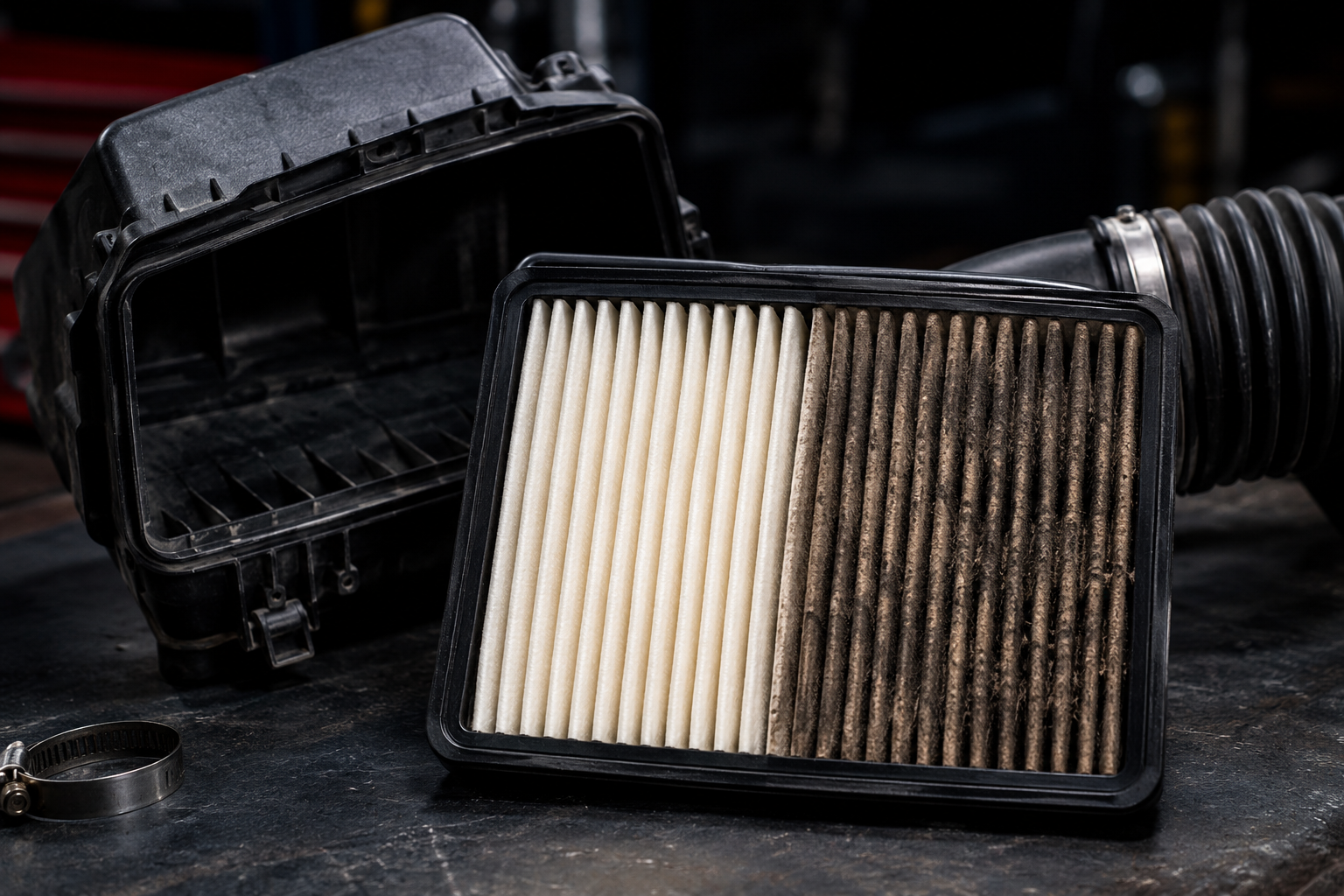
The air filter is the first line of defence for your engine. It traps dust, dirt, sand, insects, and debris before they can enter the engine and cause abrasive damage to cylinder walls, pistons, and rings. A single grain of sand that bypasses the filter can score a cylinder wall — turning what should be a $30 filter replacement into a $3,000 engine repair.
Most air filters are made from pleated paper or cotton gauze and sit inside a plastic air box connected to the intake pipe. The filter element has an enormous surface area — the pleats allow maximum airflow while capturing maximum contaminants.
Signs your air filter needs replacing:
- Visibly grey or black — holds significantly more dirt than a new filter
- Reduced fuel economy — dirty filter restricts airflow causing a rich mixture
- Sluggish acceleration — engine cannot breathe freely under load
- Rough idle from incorrect air-fuel mixture
- Black smoke from exhaust — too much fuel relative to restricted air
- Check engine light with lean or rich codes from MAF reading incorrectly through restricted filter
Hold your air filter up to a strong light source. If you cannot see light through the filter element it is overdue for replacement. A filter that looks only slightly grey may still be significantly restricted — paper filter media traps particles deep in the fibres that are not visible on the surface. When in doubt replace it — a quality air filter costs $15–$40 and takes 5 minutes to change.
2. Dirty vs Clean Air Filter — What the Difference Looks Like
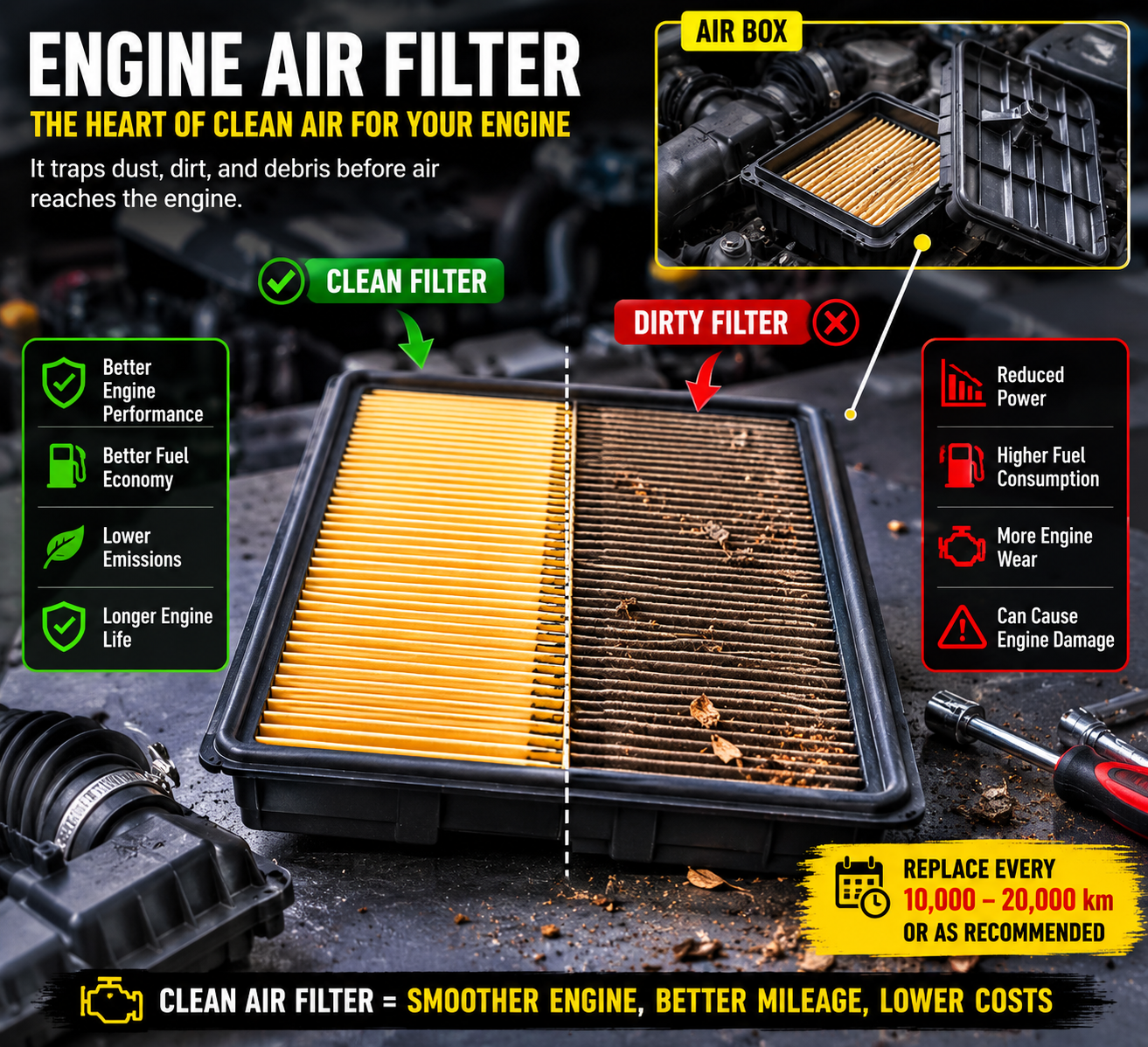
The difference between a new and a used air filter is dramatic when seen side by side. A new filter is white or light grey and passes air freely. A filter past its service life is dark brown or black and restricts airflow significantly. Many drivers wait until the filter looks like the dirty one above — by that point fuel economy and performance have already suffered for tens of thousands of kilometres.
3. Throttle Body
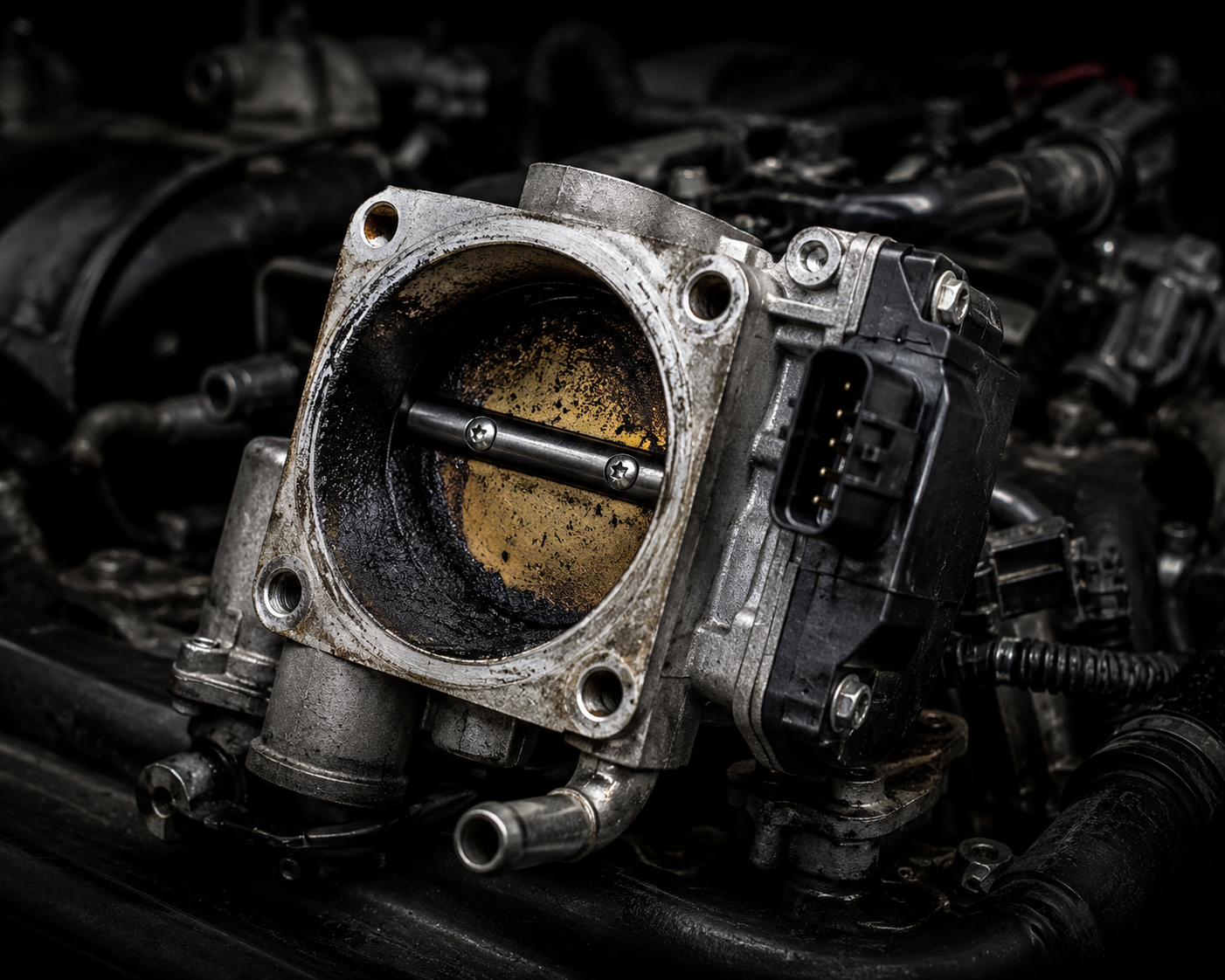
The throttle body is the gateway between the air intake system and the engine. It contains a circular butterfly valve — the throttle plate — that opens and closes to control exactly how much air enters the engine at any given moment. When you press the accelerator pedal, the throttle plate opens wider allowing more air in. The ECU then adds more fuel to match. When you release the pedal the plate closes to reduce airflow and power.
On older vehicles the throttle body was mechanically connected to the accelerator pedal via a cable. On modern vehicles it is controlled electronically — a throttle position sensor reads pedal input and the ECU commands an electric motor on the throttle body to open or close the plate. This is called drive-by-wire or electronic throttle control.
Over time carbon deposits build up on the throttle plate and bore walls — narrowing the effective opening and causing the plate to stick. This is one of the most common causes of rough idle, hesitation, and stalling on high mileage Japanese vehicles.
Symptoms of a dirty or faulty throttle body:
- Rough or unstable idle — engine RPM hunts up and down
- Hesitation when pressing the accelerator from a stop
- Engine stalls when coming to a stop at traffic lights
- Poor throttle response — lag between pressing the pedal and the engine responding
- Check engine light with throttle position sensor codes P0120–P0124
Throttle body cleaning is one of the most cost-effective maintenance tasks on a high mileage engine. Spray throttle body cleaner directly onto the plate and bore with the engine off, work the plate open and closed manually, wipe away deposits with a soft cloth. This takes 15 minutes and costs under $15 for the cleaner. Many rough idle and stalling complaints disappear immediately after a proper throttle body clean.
📺 Watch These on AutoClinic YouTube
We have covered both throttle body procedures in detail on our YouTube channel:
4. Intake Manifold
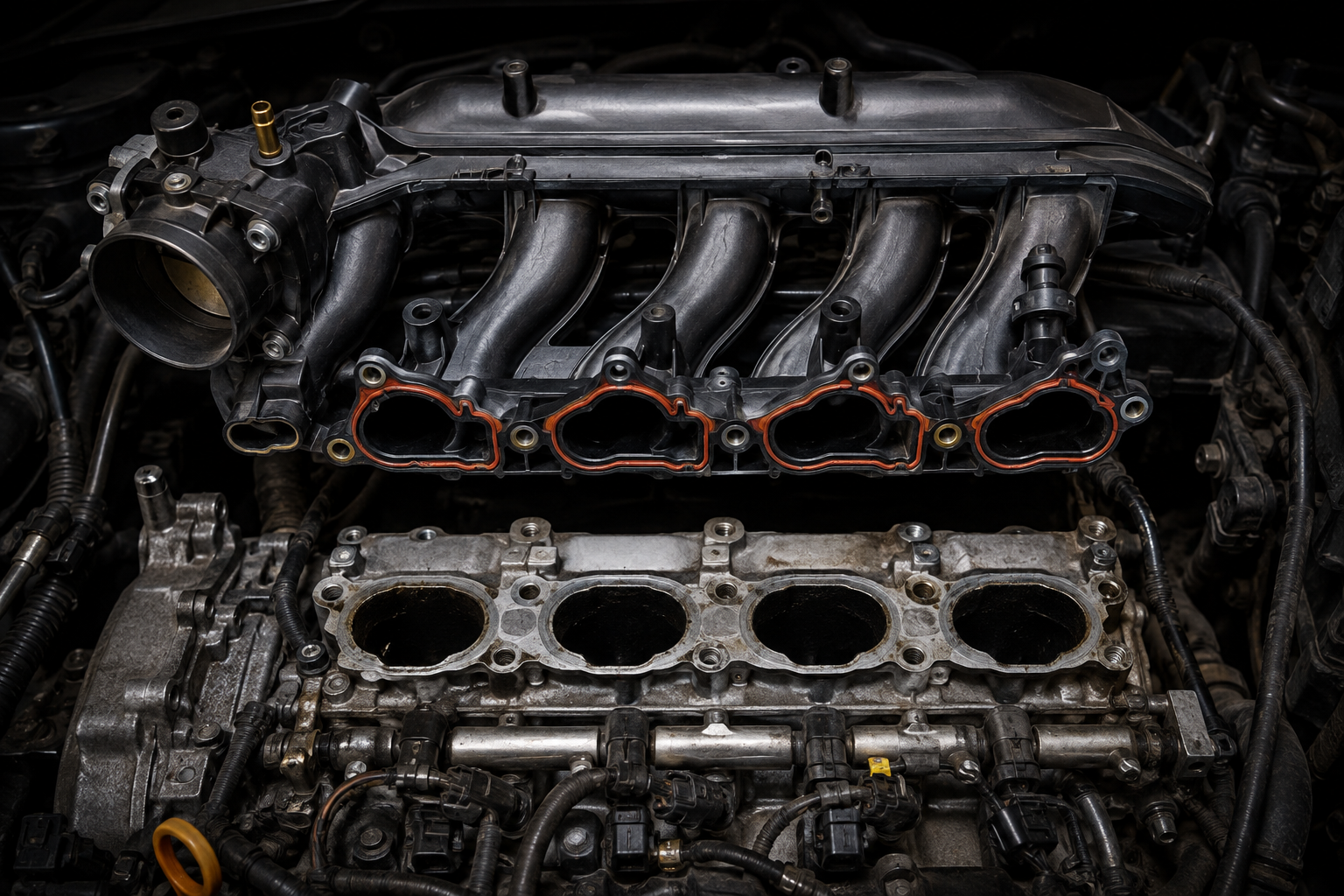
The intake manifold distributes the air coming through the throttle body evenly to each cylinder. It is a branched passage — one inlet from the throttle body splits into individual runners, one for each cylinder. The design of these runners — their length, diameter, and shape — significantly affects engine performance at different RPM ranges.
Modern intake manifolds are made from plastic or aluminium. They also house several important components:
- Fuel injectors (on port injection engines) — mounted in the manifold ports
- Intake manifold vacuum ports — supply vacuum to the brake booster, EGR system, and various sensors
- Idle air control valve — controls idle speed on older engines
- MAP sensor port — measures manifold pressure for fuel calculation
Common intake manifold problems:
- Gasket leaks — manifold gaskets fail over time allowing unmetered air into the engine causing lean running and rough idle
- Cracked manifold — plastic manifolds crack from heat cycling and age
- Carbon buildup in manifold ports — restricts airflow to individual cylinders
- Variable intake manifold runner failure — some engines use movable runners for better performance at different RPM ranges. The actuators fail over time
5. Full Air Intake System — How It All Connects
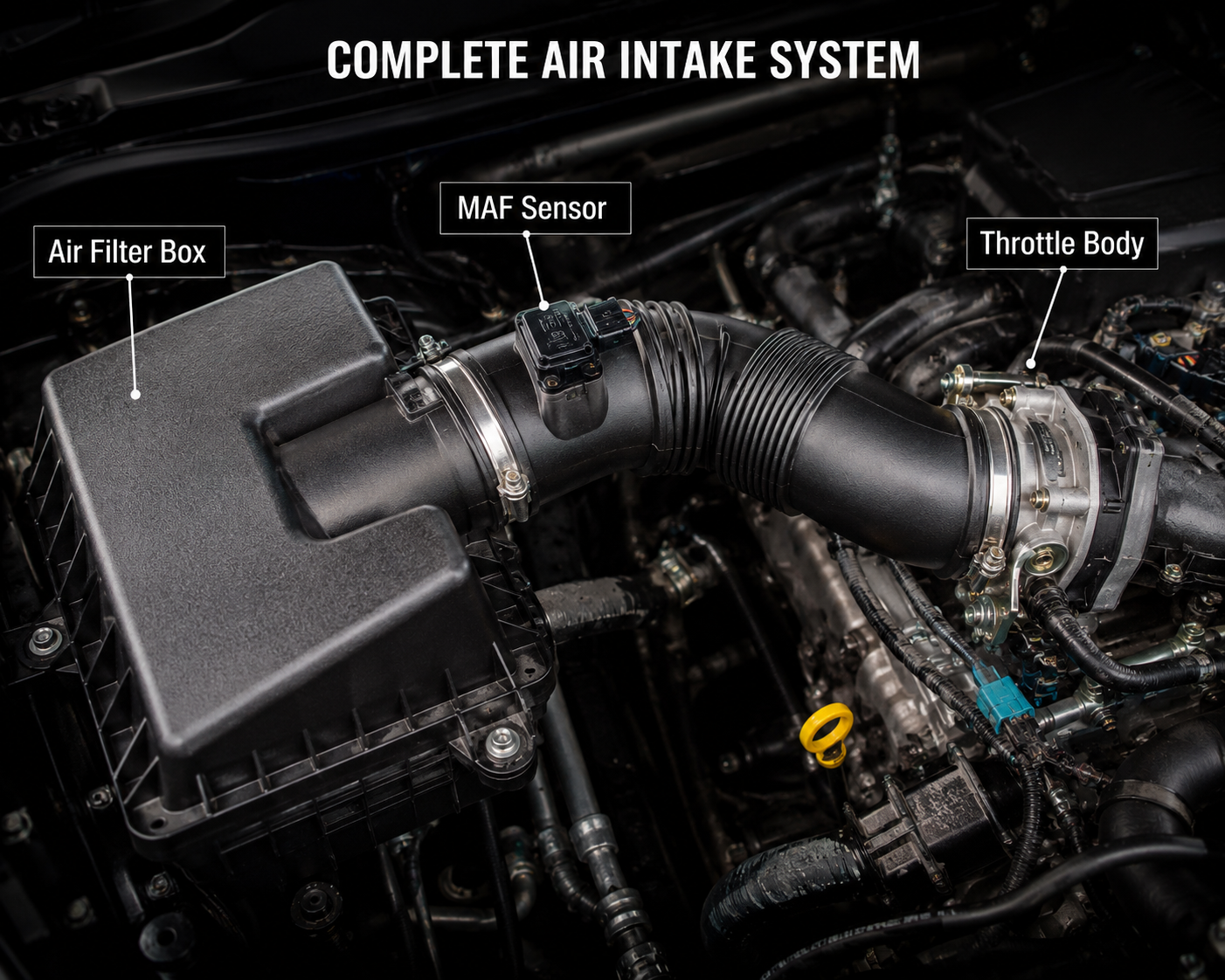
Seeing all the components connected together makes it clear how the system works as a unit. Air enters the filter box, passes through the filter element, flows down the intake pipe past the MAF sensor, through the throttle body, and into the intake manifold. Every connection in this path must be sealed correctly — any air leak between the MAF sensor and the engine allows unmetered air in, causing the ECU to calculate an incorrect fuel mixture.
6. Mass Air Flow Sensor (MAF)
The MAF sensor sits in the intake pipe between the air filter and the throttle body. It measures the volume and density of air flowing into the engine — data the ECU uses to calculate exactly how much fuel to inject. A dirty or failing MAF sensor sends incorrect readings causing the engine to run too rich or too lean.
Symptoms of a failing MAF sensor:
- Rough idle and hesitation during acceleration
- Poor fuel economy
- Black smoke from exhaust — running too rich
- Engine stalling
- Check engine light with codes P0100–P0104
7. Intake Air Temperature Sensor (IAT)
The IAT sensor measures the temperature of air entering the engine. Cold air is denser and contains more oxygen — so the ECU adds more fuel when intake air is cold. Hot air is less dense — so less fuel is needed. A failed IAT sensor causes incorrect fuel calculations, poor fuel economy, and rough running especially during cold starts.
8. PCV System — Positive Crankcase Ventilation
The PCV system routes blow-by gases from the engine crankcase back into the intake manifold to be burned rather than vented to atmosphere. While this is important for emissions, it also introduces oil vapour into the intake system — which is the primary cause of carbon buildup on intake valves in GDI engines and throttle body deposits on all engines.
A blocked PCV valve causes:
- Increased oil consumption — blow-by cannot escape and pressurizes the crankcase
- Oil leaks from seals and gaskets pushed out by excess crankcase pressure
- Rough idle from incorrect intake vacuum
- Excessive carbon buildup in the intake system
Vacuum Leaks — The Hidden Air Intake Problem
Any unintended air entering the engine between the MAF sensor and the combustion chamber is called a vacuum leak. Because this air is not measured by the MAF sensor, the ECU does not add fuel to match it — causing a lean mixture and rough running. Vacuum leaks are one of the most common causes of rough idle and hesitation on older Japanese vehicles.
Common vacuum leak locations:
- Cracked or loose intake hose between MAF sensor and throttle body
- Failed intake manifold gasket
- Cracked or disconnected vacuum hose
- Failed throttle body gasket
- Cracked intake manifold
How to find a vacuum leak:
- Listen for a hissing sound with the engine running
- Spray carburettor cleaner around intake joints and hoses — if engine RPM changes you have found the leak
- Use a smoke machine — a workshop tool that pressurizes the intake with smoke to reveal leak points visually
Never use flammable spray near the exhaust or ignition components when testing for vacuum leaks. Carburettor cleaner is highly flammable. Spray in short bursts, keep the can away from hot surfaces, and have a fire extinguisher nearby. A safer alternative is to use unlit propane gas from a torch — the engine RPM will change if propane enters a vacuum leak without the fire risk of flammable sprays.
Stock Air Intake vs Cold Air Intake
| Feature | Stock Air Intake | Cold Air Intake (Aftermarket) |
|---|---|---|
| Air temperature | Draws warm air from engine bay | Draws cooler air from lower in the engine bay |
| Power gain | Standard | Small gain — 5–15 hp on most engines |
| Fuel economy | Standard | Marginal improvement possible |
| Sound | Quiet | Louder induction noise under acceleration |
| Engine protection | Full filtration | Depends on filter quality — some offer less protection |
| Hydrolocking risk | None | Risk if placed too low and driven through water |
| Cost | Standard | $100–$400 for quality brands |
Air Intake Maintenance Schedule
| Service | Interval | Why |
|---|---|---|
| Air filter replacement | Every 15,000–30,000 km or annually | Maintains unrestricted airflow to engine |
| Throttle body cleaning | Every 40,000–60,000 km | Prevents idle problems and carbon buildup |
| MAF sensor cleaning | Every 30,000–50,000 km | Maintains accurate air measurement |
| PCV valve replacement | Every 40,000–80,000 km | Prevents crankcase pressure buildup |
| Intake hose inspection | Annually | Check for cracks and loose connections |
Common Air Intake Problems — Diagnosis Table
| Symptom | Most Likely Cause | Urgency |
|---|---|---|
| Rough idle, engine hunts for RPM | Vacuum leak or dirty throttle body | High |
| Hesitation under acceleration | Dirty MAF sensor or clogged air filter | High |
| Engine stalls at traffic lights | Dirty throttle body or IAC valve | High |
| Poor fuel economy | Clogged air filter or dirty MAF sensor | Medium |
| Black smoke from exhaust | Severely restricted air filter | High |
| Hissing noise from engine bay | Vacuum leak — cracked hose or gasket | High |
| Check engine light P0100–P0104 | MAF sensor failure | High |
| Oil leaks from multiple locations | Blocked PCV valve — crankcase pressure | Medium |
Estimated Repair Costs
| Service or Repair | Estimated Cost |
|---|---|
| Air filter replacement (DIY) | $15–$40 |
| Air filter replacement (workshop) | $40–$80 including labour |
| Throttle body cleaning (DIY) | $10–$20 for cleaner |
| Throttle body cleaning (workshop) | $60–$150 |
| MAF sensor cleaning | $15–$30 DIY / $60–$100 workshop |
| MAF sensor replacement | $100–$350 |
| PCV valve replacement | $30–$100 |
| Vacuum hose replacement | $50–$200 depending on location |
| Intake manifold gasket replacement | $200–$600 |
| Intake manifold replacement | $300–$800 |
How To Keep Your Air Intake System Healthy
- Replace the air filter on schedule — it is one of the cheapest and most effective maintenance items on any car
- Inspect intake hoses and connections annually for cracks, splits, or loose clamps
- Clean the throttle body every 40,000 km — particularly important on Japanese vehicles used in dusty Kenyan conditions
- Never drive through deep water — water ingested through the air intake causes hydraulic lock which bends connecting rods and destroys the engine instantly
- Use genuine or quality aftermarket air filters — cheap filters use thinner filter media that allows more particles through and collapses under suction
- If fitting a cold air intake position the filter away from water splash zones — a hydrolocked engine from water ingestion is one of the most expensive no-fault engine failures
FAQ
How often should I replace my air filter? Every 15,000–30,000 km under normal conditions — or annually whichever comes first. In dusty driving conditions such as unpaved roads, replace every 10,000–15,000 km. Always inspect it visually at every service — a heavily used filter may need replacement sooner than the interval suggests.
Can a dirty air filter cause the check engine light to come on? Yes — a severely restricted air filter reduces airflow enough that the MAF sensor detects an abnormally low reading. The ECU may log lean codes, rich codes, or MAF circuit codes depending on how the system responds to restricted airflow.
What happens if I drive without an air filter? Never do this even for a short distance. Without the filter, dust and debris enter the engine directly — causing rapid abrasive wear to cylinder walls, piston rings, and valve seats. Damage begins immediately and can require an engine rebuild after even a short period of unfiltered running.
Can I clean and reuse a paper air filter? Compressed air can dislodge loose surface dust and extend filter life slightly — but paper filter media cannot be washed and reused like cotton gauze performance filters. Once a paper filter is saturated with fine particles embedded in the media, cleaning does not restore full airflow. Replace it.
My car has a loud sucking noise under acceleration — is that normal? A moderate induction sound is normal — it is the sound of the engine drawing in air. If a new louder hissing or sucking sound appeared suddenly, it likely indicates a split intake hose or loose connection between the MAF sensor and throttle body. This is a vacuum leak and causes rough running and poor fuel economy — inspect the intake hose and all clamps immediately.
More From Engine
 Engine
How Your Car's Fuel System Works — Components, Problems and Fixes
Your fuel system delivers clean fuel at the right pressure to keep your engine running. Here is how every component works and what happens when any one of them fails
Aug 25, 2026 5 min
Read more  Engine
How a Car Radiator Works — and What Goes Wrong
Your radiator keeps your engine from destroying itself. Here is how it works, what goes wrong, and how to maintain it before it causes an expensive breakdown.
Aug 20, 2026 5 min
Read more  Engine
Car Shakes or Vibrates When Braking — Causes and Fix
Vibration through the steering wheel or brake pedal when stopping is one of the most common brake complaints. Here is what is causing it and what it costs to fix properly.
Aug 11, 2026 5 min
Read more