You press the brake pedal and immediately feel a pulsing vibration — through the pedal itself, through the steering wheel, or through the entire car. The harder you brake, the worse it gets. This is one of the most common brake complaints — and while warped rotors are the most frequent cause, several other problems produce identical symptoms and are often misdiagnosed.
Engine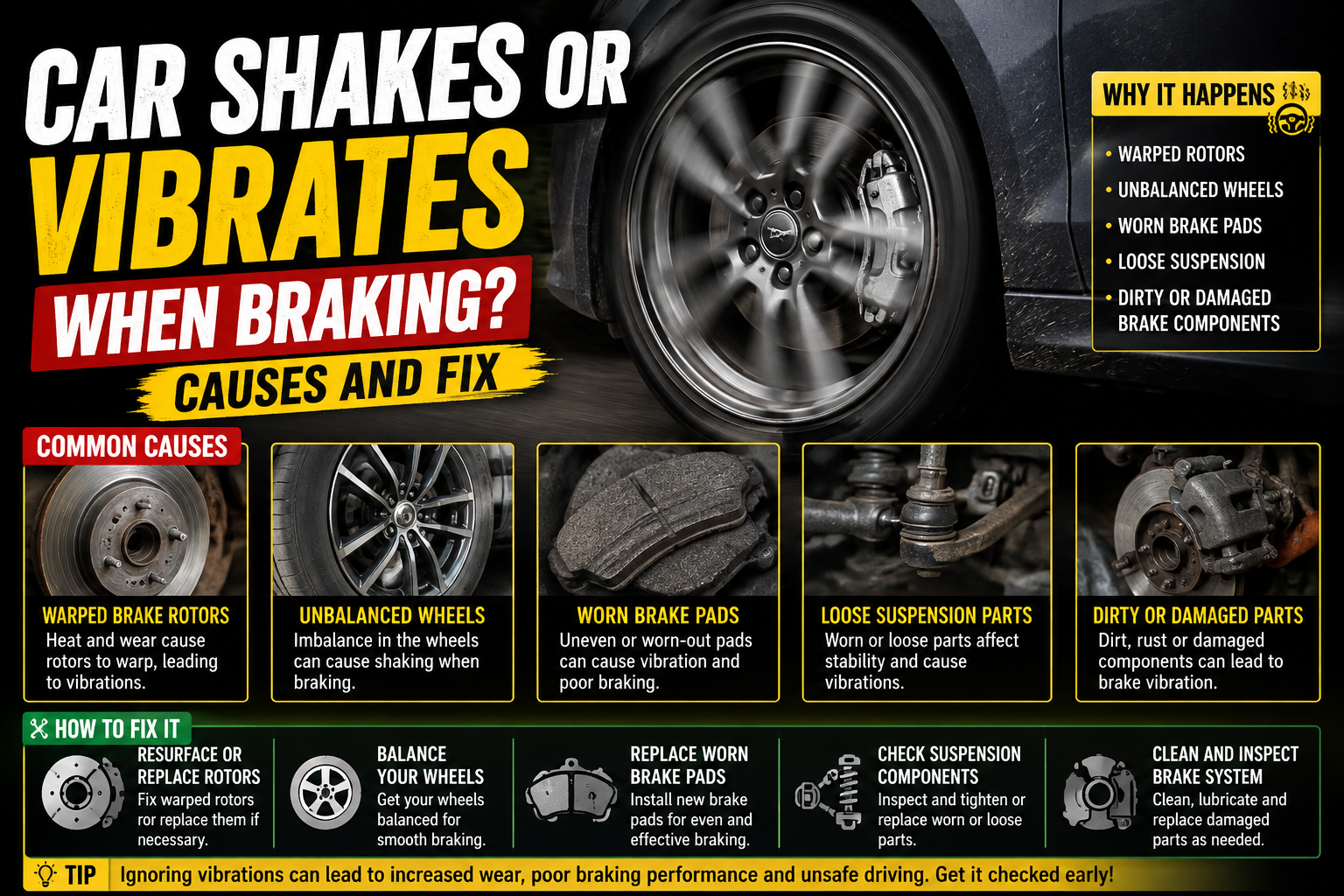
Engine
Car Shakes or Vibrates When Braking — Causes and Fix
August 11, 2026 5 min readEngine
Vibration through the steering wheel or brake pedal when stopping is one of the most common brake complaints. Here is what is causing it and what it costs to fix properly.
Written by
Car Guide CrewThe Car Guide Crew editorial team publishes practical, mechanic-verified automotive knowledge — helping drivers understand, diagnose, and maintain their vehicles.
DiagnosticsEngine SystemsMaintenanceElectrical Systems
Published: Aug 11, 2026
How Brakes Are Supposed to Work
For smooth, vibration-free braking the brake rotor must be perfectly flat — within a few thousandths of a millimetre across its entire surface. When the brake caliper clamps the pads against the rotor, the friction surface must be uniform. Any variation in rotor thickness or surface evenness creates a pulsing force with each wheel rotation — which you feel as vibration.
Cause 1 — Uneven Rotor Surface (Most Common)
The term warped rotor is widely used but slightly misleading. What actually causes most brake vibration is uneven pad material transfer onto the rotor surface.
Here is what happens:
- Brake pads are designed to transfer a thin, even layer of friction material onto the rotor surface during normal use
- When brakes are applied for a long time — such as descending a mountain — the rotor gets very hot
- Parking with hot brakes leaves the hot pad in contact with the hot rotor at one spot
- That spot gets a heavier deposit of pad material than the rest of the rotor
- The uneven deposit creates a high spot that the brake pad hits every rotation — causing the pulsing vibration
The classic way to cause brake vibration: drive down a long hill using the brakes continuously, then stop at the bottom and park. The pads sit on a very hot rotor and transfer material unevenly. The fix: on long descents use engine braking in a lower gear with brief firm brake applications — never sustained light pressure. After hard braking allow the brakes to cool by driving slowly for a few minutes before stopping.
Cause 2 — Worn or Loose Wheel Bearings
A worn wheel bearing allows the wheel to have slight lateral movement — play that is normally invisible during straight driving but becomes amplified under braking load. As the brakes apply force the loose bearing allows the rotor to wobble slightly, creating vibration that can feel identical to rotor problems.
How to distinguish bearing vibration from rotor vibration:
- Rotor vibration — felt primarily in the brake pedal, worst under moderate to hard braking
- Bearing vibration — felt throughout the car including the seat, may also include a humming or rumbling noise while driving that changes with speed
Cause 3 — Loose Wheel Nuts
A wheel that is not properly torqued to the hub will vibrate under braking as the braking force amplifies any play between the wheel and hub. This is most common after a recent tyre change where the wheel nuts were not torqued correctly.
If braking vibration started immediately after a tyre change, check wheel nut torque immediately. A wheel that comes loose at highway speed is a catastrophic safety failure. Do not drive at speed until wheel nuts have been verified to the correct torque specification — typically 85–120 Nm depending on the vehicle.
Cause 4 — Sticking Brake Caliper
A caliper that does not release fully after braking keeps constant pressure on one area of the rotor. This generates sustained heat in that area and causes uneven rotor surface wear — which leads to vibration. A sticking caliper also causes:
- Vehicle pulling to one side during and after braking
- Excessive heat from one wheel — the wheel may be noticeably hotter than others after driving
- Burning smell from one wheel area
- Faster wear on one side — that brake pad wears faster than others
Cause 5 — Worn Suspension Components
Worn ball joints, tie rod ends, or control arm bushings have play in them that is normally masked during driving. Under the controlled, linear stress of braking that play is exposed — causing a vibration that emanates from the suspension rather than the brakes themselves.
How To Identify Which Axle Is Causing the Problem
| Vibration Location | Most Likely Source |
|---|---|
| Steering wheel shakes during braking | Front axle — front rotors or front wheel bearings |
| Seat and floor vibrate but not steering wheel | Rear axle — rear rotors or rear wheel bearings |
| Entire car shakes including steering wheel | Both axles or severe single axle problem |
| Brake pedal pulses but no steering wheel shake | Rear rotor problem specifically |
| Vehicle pulls to one side while vibrating | Sticking caliper on pull side |
Is It Safe To Drive With Brake Vibration?
Mild vibration from uneven rotor surfaces is driveable for a short period but should be addressed promptly — it indicates the braking system is not performing at full efficiency and will get worse over time.
Do not drive normally if:
- The vibration is severe and affects vehicle control while braking
- The vehicle pulls strongly to one side under braking — sticking caliper
- The vibration started immediately after a tyre change — check wheel nuts first
- The brake pedal feels soft alongside the vibration
Rotor Resurface vs Replacement
Resurface the rotors: A lathe removes a thin layer from the rotor surface to create a new flat surface. This only works if the rotor is thick enough — rotors have a minimum thickness specification and cannot be machined below it.
Replace the rotors: New rotors are recommended when the existing rotor is below minimum thickness, is deeply grooved, or has hard spots from overheating. On high-mileage vehicles replacing rather than resurfacing often makes more long-term sense.
How To Prevent Brake Vibration
- Use engine braking on long descents — do not ride the brakes continuously
- After hard braking drive slowly for 2-3 minutes to allow brake cooling before parking
- Check wheel nut torque after every tyre rotation or change
- Have wheel bearings inspected at each brake service
- Address caliper sticking early — seized caliper slides are cheap to service if caught early
Estimated Repair Costs
| Repair | Estimated Cost |
|---|---|
| Rotor resurface per rotor | $40–$80 per rotor |
| New rotors per axle | $150–$400 |
| New rotors and pads per axle | $250–$600 |
| Caliper service (slides and seals) | $80–$150 per caliper |
| New caliper | $200–$500 per caliper |
| Wheel bearing replacement | $200–$500 per bearing |
| Ball joint replacement | $150–$400 per joint |
FAQ
Can brake vibration go away on its own? Occasionally mild uneven rotor deposits can self-correct through normal braking — but this is rare and unreliable. Most brake vibration requires mechanical correction.
My brakes were just replaced and now they vibrate — why? New rotors and pads need to be properly bedded in. If the vibration started immediately after installation the rotors may have been improperly installed, the wrong specification was used, or the wheel nuts were over-torqued creating rotor distortion.
Is brake vibration dangerous? Mild vibration reduces braking efficiency slightly. Severe vibration that affects steering control or vehicle stability during braking is genuinely dangerous and requires immediate attention.
My car only vibrates when braking from high speed but not from low speed — what does that mean? Rotor problems are more noticeable at higher speeds because the rotor completes more rotations per second — the pulsing frequency is higher and more pronounced. This is a classic rotor vibration symptom rather than a bearing or suspension issue which tends to be consistent across speeds.
More From Engine
 Engine
Squealing or Grinding Noise When Braking — Should You Stop Driving?
Brake noise is never random. Squealing means something specific. Grinding means something else entirely — and one of them requires you to stop driving immediately.
Aug 11, 2026 5 min
Read more  Engine
Car Cranks But Won't Start — Here Is What Is Wrong
The engine turns over but never fires. Here is the exact diagnostic process mechanics use to find the cause fast.
Aug 8, 2026 5 min
Read more  Engine
Knocking Noise From Engine — What It Means and What To Do
That knocking sound from your engine is not normal — it is a warning. Here is what is causing it and how serious it really is.
Aug 8, 2026 5 min
Read more