Your brakes communicate directly with you through sound. Unlike many car problems that require diagnostic equipment to identify, brake problems make themselves known audibly. The challenge is interpreting what each sound means — because squealing and grinding have completely different causes, different urgency levels, and different repair costs.
Engine
Engine
Squealing or Grinding Noise When Braking — Should You Stop Driving?
August 11, 2026 5 min readEngine
Brake noise is never random. Squealing means something specific. Grinding means something else entirely — and one of them requires you to stop driving immediately.
Written by
Car Guide CrewThe Car Guide Crew editorial team publishes practical, mechanic-verified automotive knowledge — helping drivers understand, diagnose, and maintain their vehicles.
DiagnosticsEngine SystemsMaintenanceElectrical Systems
Published: Aug 11, 2026
Understanding Brake Pad Wear Indicators
Every brake pad has a wear indicator — a small metal tab attached to the pad backing plate. This tab is deliberately positioned so that when the brake pad wears down to approximately 2-3mm of remaining material, the tab contacts the brake rotor surface. The resulting metal-on-metal contact produces the squealing sound you hear. This is intentional — it is the pad telling you it needs replacement before it wears completely through.
Squealing Brakes — What It Means
Cause 1 — Wear Indicator Contact (Most Common)
Happens during normal braking. Continuous or frequent squeal throughout most stops. Gets louder over days and weeks. This squeal means you have days to weeks before the pads wear through completely — act soon but not immediately.
Cause 2 — Morning Squeal From Surface Rust
Overnight surface rust forms on brake rotors in humid conditions. The first few stops of the morning scrape this rust off — producing a brief squeal that disappears completely within 2-3 stops. This is completely normal and requires no action.
Cause 3 — Glazed Brake Pads
Sustained light braking — such as riding the brakes downhill — generates sustained heat that glazes the pad surface. Glazed pads squeal under light braking and have reduced stopping power.
Cause 4 — Cheap or Incorrect Brake Pads
Low quality aftermarket brake pads often use harder compounds that squeal throughout their entire life. If brakes were recently replaced and immediately started squealing, the pad compound is likely the cause.
If your brakes squeal only in the morning on the first few stops and then go quiet for the rest of the day — that is normal rotor rust and not a problem. If they squeal on every stop throughout the day — that is wear indicators and the pads need replacement within the next few weeks.
Grinding Brakes — Stop Driving
A deep, harsh grinding or metal scraping sound during braking means the brake pads have worn completely through — past the friction material, past the wear indicator, and down to the bare metal backing plate. That metal plate is now making direct contact with the brake rotor surface.
Grinding brakes require immediate attention. Every stop with metal-on-metal contact destroys the rotor surface — turning what would have been a $150 pad replacement into a $400-600 pad and rotor replacement. More critically, a brake system in this condition has significantly reduced stopping power. Do not drive normally with grinding brakes — get to a workshop directly.
What Happens if You Continue Driving With Grinding Brakes
Stage 1 — Metal backing contacts rotor, rotor surface is scored and grooved. Stopping distance increases.
Stage 2 — Rotor is deeply grooved and beginning to crack from thermal stress. Caliper piston may over-extend.
Stage 3 — Caliper piston seal fails, brake fluid leaks. Brake pedal goes soft. Complete brake failure possible.
Other Brake Noises and What They Mean
| Noise | When It Happens | Most Likely Cause | Urgency |
|---|---|---|---|
| High-pitched squeal every stop | All braking | Wear indicators — pads near end of life | High — replace within weeks |
| Morning squeal, clears after 2-3 stops | First stops of the day only | Normal surface rust | None — completely normal |
| Deep metal grinding | All braking | Pads worn through — metal on metal | Very High — stop driving normally |
| Scraping when not braking | While driving, not braking | Debris caught between pad and rotor | Medium — inspect soon |
| Clunking or thudding when braking | Hard braking | Loose caliper, worn caliper bracket | High — affects control |
| Squeal plus steering wheel vibration | During braking | Warped rotor plus worn pads | High |
| Grinding only when reversing | Reverse only | Debris in rear drum, rear shoe issue | Medium |
How To Check Your Own Brake Pad Thickness
Look through the wheel spokes at the brake caliper — you can usually see the pad material between the caliper and the rotor.
- More than 6mm of pad material visible — pads are fine
- 3-5mm visible — pads are getting low, plan for replacement soon
- Less than 3mm visible — pads need replacement now
- No pad material visible, only metal — emergency, do not drive
How To Make Brake Pads Last Longer
- Avoid riding the brakes on long descents — use engine braking in lower gears instead
- Increase following distance — allows earlier, gentler braking instead of late hard stops
- Do not rest your left foot on the brake pedal while driving — even slight pressure accelerates pad wear dramatically
- Allow brakes to cool after extended mountain driving before parking
Estimated Repair Costs
| Repair | Estimated Cost |
|---|---|
| Front brake pads only | $100–$250 per axle |
| Rear brake pads only | $80–$200 per axle |
| Pads and rotor resurface (front) | $200–$400 per axle |
| Pads and new rotors (front) | $300–$600 per axle |
| Full brake service — all four corners | $500–$1,200 |
| Caliper replacement | $200–$500 per caliper |
FAQ
Is it safe to drive with squealing brakes? If the squeal is the wear indicator — yes for a short time, but the pads need replacement within days to weeks. If the brakes are grinding — no, the vehicle needs immediate attention.
Why do my new brakes squeal? New brake pads often squeal during the first 200-300 km as they bed in and conform to the rotor surface. This is normal and resolves on its own. If squealing continues beyond 500 km the pad compound or installation may be the issue.
Can I just replace front brake pads and leave the rear? If only the front pads are worn — yes. Brakes wear unevenly because the front brakes do approximately 70% of the braking work. Inspect the rear while the front is being done and replace if below 4mm.
Do rotors always need replacing when pads are replaced? Not always. If the rotor surface is within the minimum thickness specification and is not warped or deeply grooved, it can be resurfaced or left in place with new pads. Your mechanic should measure rotor thickness before deciding.
More From Engine
 Engine
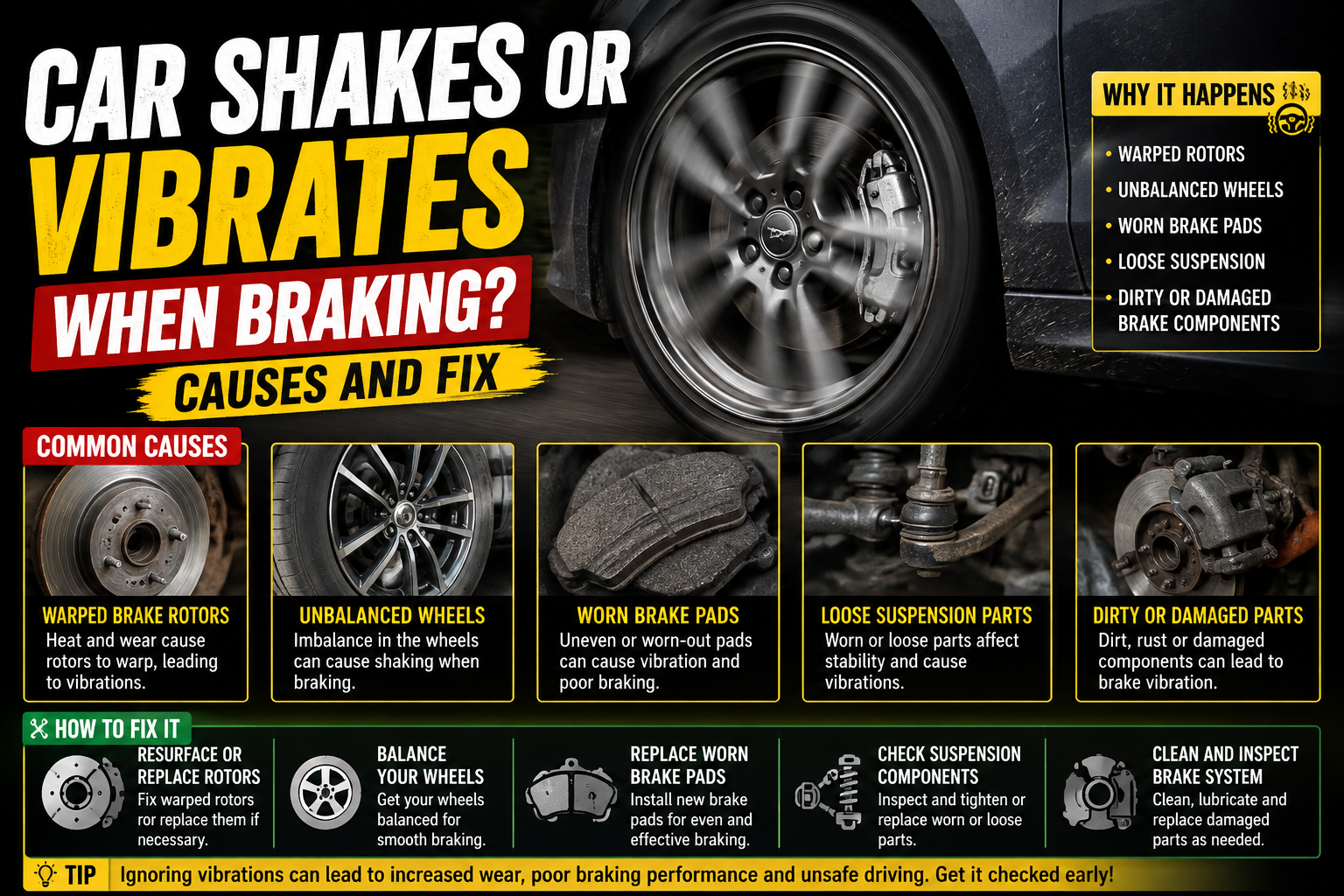
Car Shakes or Vibrates When Braking — Causes and Fix
Vibration through the steering wheel or brake pedal when stopping is one of the most common brake complaints. Here is what is causing it and what it costs to fix properly.
Aug 11, 2026 5 min
Read more  Engine
Car Cranks But Won't Start — Here Is What Is Wrong
The engine turns over but never fires. Here is the exact diagnostic process mechanics use to find the cause fast.
Aug 8, 2026 5 min
Read more  Engine
Knocking Noise From Engine — What It Means and What To Do
That knocking sound from your engine is not normal — it is a warning. Here is what is causing it and how serious it really is.
Aug 8, 2026 5 min
Read more