Spark plugs are among the smallest and least expensive components in your engine — but their impact on engine performance is enormous. A spark plug that is worn, fouled, or incorrectly gapped causes incomplete combustion in that cylinder every single time the engine fires. Multiply that across four, six, or eight cylinders over thousands of kilometres and the cumulative damage to your fuel economy, catalytic converter, and ignition system adds up quickly.
Engine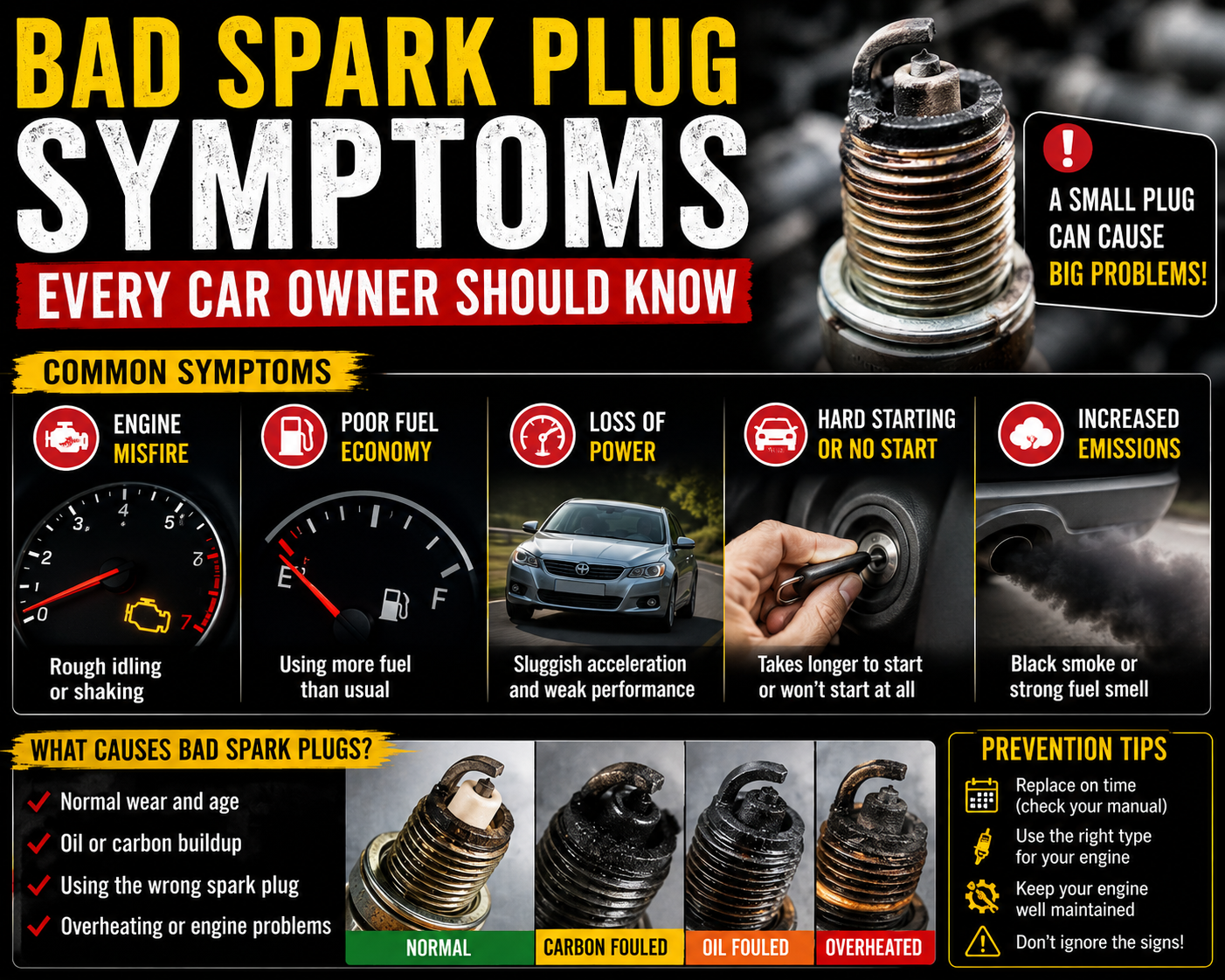
Engine
Bad Spark Plug Symptoms Every Car Owner Should Know
February 12, 2026 5 min readEngine
Rough idle, misfires, poor fuel economy — spark plugs touch all of it. Here's how to spot a worn set.
Written by
Car Guide CrewThe Car Guide Crew editorial team publishes practical, mechanic-verified automotive knowledge — helping drivers understand, diagnose, and maintain their vehicles.
DiagnosticsEngine SystemsMaintenanceElectrical Systems
Published: Feb 12, 2026
What Spark Plugs Actually Do
A spark plug does one job — it creates the precisely timed electrical spark that ignites the compressed air-fuel mixture inside the cylinder. The quality and timing of this spark determines how completely the fuel burns, how much power is produced, and how efficiently the engine runs.
Inside each spark plug a high voltage electrical discharge jumps across a small gap between the center electrode and the ground electrode. This gap must be precisely set to the manufacturer's specification. Too wide and the spark is weak. Too narrow and it fires at the wrong time. As electrodes wear the gap widens and the spark weakens.
Common Symptoms of Bad Spark Plugs
1. Rough Idle
A healthy engine idles smoothly and quietly. A cylinder with a failing spark plug misfires — sometimes firing correctly, sometimes not — creating an uneven power delivery that makes the engine shake, vibrate, or sound like it is stumbling at idle.
The rough idle from a bad spark plug is typically most noticeable:
- When sitting at a traffic light
- When the engine is cold and has not reached operating temperature
- At very low RPM in gear
2. Engine Misfire
A misfire is when combustion in a cylinder fails to occur or occurs incorrectly. You feel it as a sudden jerk or stumble — as if the engine briefly lost power. At idle it causes shaking. Under acceleration it causes hesitation and surging.
A misfiring cylinder sends raw unburned fuel into the exhaust system. This fuel ignites inside the catalytic converter causing it to overheat. Extended driving with a misfiring spark plug can destroy a catalytic converter in a matter of hours — turning a $15 spark plug into a $1,500 repair. Never ignore a flashing check engine light.
3. Poor Fuel Economy
When combustion is incomplete due to a weak spark, not all the fuel in the cylinder burns. This wasted fuel exits through the exhaust without producing power — meaning the engine needs more fuel to do the same work. A measurable decrease in fuel economy of 10% or more with no other obvious cause is a common early indicator of aging spark plugs.
4. Hard Starting
A cold engine needs a strong, reliable spark to ignite a rich cold-start fuel mixture. Worn or fouled spark plugs that struggle to fire under normal conditions often fail entirely when cold starting demands peak performance from them. The engine cranks longer than normal before catching — or requires multiple attempts to start.
5. Sluggish Acceleration
Under acceleration the engine demands maximum combustion efficiency from every cylinder simultaneously. A cylinder with a weak spark plug contributes less power than it should — making acceleration feel sluggish, especially when pulling away from a stop, overtaking, or climbing hills.
6. Check Engine Light with Misfire Codes
| Fault Code | Meaning |
|---|---|
| P0300 | Random/multiple cylinder misfire |
| P0301 | Cylinder 1 misfire |
| P0302 | Cylinder 2 misfire |
| P0303 | Cylinder 3 misfire |
| P0304 | Cylinder 4 misfire |
What Worn Spark Plugs Look Like
| Plug Appearance | What It Indicates | Action |
|---|---|---|
| Light tan or grey deposits, slight electrode wear | Normal wear — approaching end of service life | Replace at service interval |
| Black sooty carbon deposits | Running rich — too much fuel, weak spark | Replace plugs, investigate fuel system |
| Oily black deposits | Oil entering combustion chamber | Replace plugs, investigate oil consumption |
| White or light grey blistering | Overheating — wrong heat range or lean mixture | Replace plugs, investigate cause |
| Worn or rounded electrodes | Normal wear — plug past service life | Replace immediately |
| Cracked insulator | Physical damage | Replace immediately |
Causes of Premature Spark Plug Failure
- Oil contamination — worn piston rings or valve seals allow oil into the combustion chamber, fouling plugs rapidly
- Rich fuel mixture — excessive fuel from a faulty injector or failed O2 sensor causes carbon fouling
- Incorrect heat range — using the wrong specification plug causes either fouling (too cold) or overheating (too hot)
- Pre-ignition or detonation — engine knock damages plug electrodes and insulators
- Extended service intervals — using standard plugs past their replacement interval allows excessive electrode wear
How Often To Replace Spark Plugs
| Plug Type | Material | Service Interval |
|---|---|---|
| Standard copper core | Copper/nickel | Every 30,000–50,000 km |
| Platinum plugs | Platinum tip | Every 60,000–100,000 km |
| Double platinum plugs | Platinum both electrodes | Every 80,000–120,000 km |
| Iridium plugs | Iridium tip | Every 100,000–160,000 km |
Always replace the full set of spark plugs at the same time — not just the one that failed. If one plug has reached the end of its service life all the others are close behind. Replacing one now means pulling the engine cover again in a few thousand kilometres. Do the full set once and reset the service interval for all of them together.
Estimated Costs
| Service | Estimated Cost |
|---|---|
| Standard copper plugs (set of 4) | $20–$60 |
| Iridium plugs (set of 4) | $60–$150 |
| Labor — 4 cylinder engine | $50–$150 |
| Labor — 6 cylinder engine | $100–$250 |
| Labor — V8 engine | $150–$400 |
| Catalytic converter (if damaged by misfire) | $800–$2,500 |
FAQ
Can bad spark plugs damage the engine? Indirectly yes — through catalytic converter damage from misfires, and through detonation caused by weak spark in high compression engines. The plugs themselves do not cause internal engine damage but the consequences of ignoring them do.
Will new spark plugs fix a rough idle? If the rough idle is caused by spark plug misfires — yes. If it is caused by a vacuum leak, MAF sensor fault, or fuel system issue — no. Scan for fault codes first to confirm misfire codes before replacing plugs.
Is there a difference between spark plug brands? Yes — use the manufacturer-specified brand and specification where possible. NGK and Denso are the OEM suppliers for most Japanese vehicles and generally offer the best quality and compatibility for Toyota, Honda, and Subaru engines.
My car has 120,000 km and the spark plugs have never been changed — should I replace them? Absolutely. Even iridium plugs have a service limit. At 120,000 km without replacement you almost certainly have significant electrode wear contributing to poor fuel economy and reduced performance. Replace the full set immediately.
More From Engine
 Engine
Car Shakes or Vibrates When Braking — Causes and Fix
Vibration through the steering wheel or brake pedal when stopping is one of the most common brake complaints. Here is what is causing it and what it costs to fix properly.
Aug 11, 2026 5 min
Read more  Engine
Squealing or Grinding Noise When Braking — Should You Stop Driving?
Brake noise is never random. Squealing means something specific. Grinding means something else entirely — and one of them requires you to stop driving immediately.
Aug 11, 2026 5 min
Read more  Engine
Car Cranks But Won't Start — Here Is What Is Wrong
The engine turns over but never fires. Here is the exact diagnostic process mechanics use to find the cause fast.
Aug 8, 2026 5 min
Read more