Carbon buildup in modern engines is one of the most misunderstood and underdiagnosed problems in automotive maintenance. It does not announce itself with a warning light. It does not cause a sudden breakdown. Instead it slowly and silently steals power, increases fuel consumption, and creates misfires — until one day your engine is running so roughly you finally take it to a mechanic who shows you valves coated in thick black carbon deposits.
Engine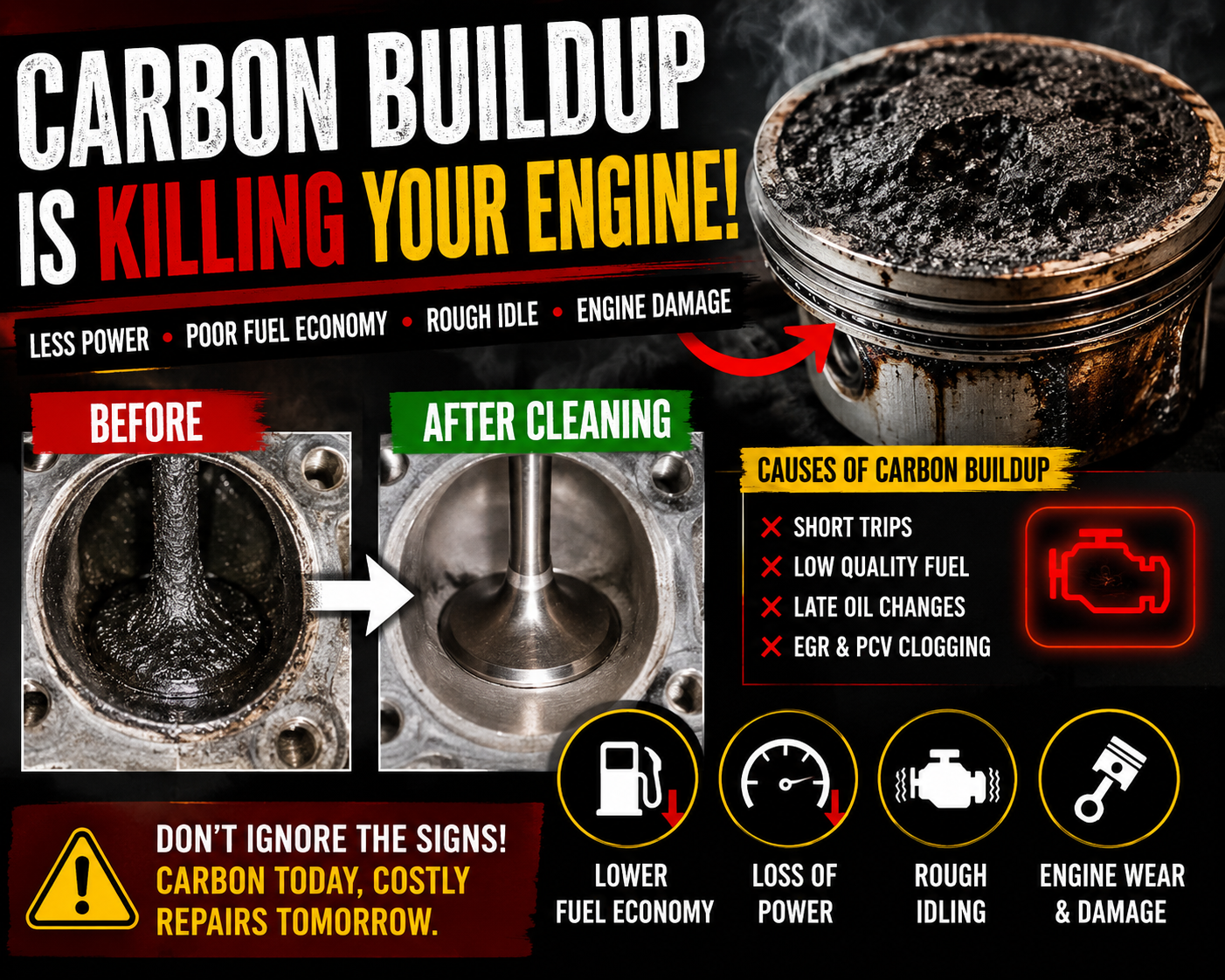
Engine
Carbon Buildup Is Killing Your Engine — How to Clean It
February 15, 2026 9 min readEngine
Direct-injection engines suffer from carbon deposits that strangle power. Here's how to clean them properly.
Written by
Car Guide CrewThe Car Guide Crew editorial team publishes practical, mechanic-verified automotive knowledge — helping drivers understand, diagnose, and maintain their vehicles.
DiagnosticsEngine SystemsMaintenanceElectrical Systems
Published: Feb 15, 2026
What Is Carbon Buildup and Where Does It Form?
Carbon deposits are the result of incomplete combustion — oil vapors, fuel residue, and combustion byproducts that do not fully burn and instead accumulate on engine surfaces as a hard black coating.
The most common locations for carbon buildup:
- Intake valves — the most critical and problematic location, especially on GDI engines
- Throttle body — the butterfly valve that controls airflow into the engine
- Intake manifold ports — the passages leading to the intake valves
- Piston tops — affects combustion efficiency and can cause hot spots
- EGR valve and passages — recirculated exhaust gases carry carbon into the intake
Why Modern GDI Engines Are More Vulnerable
Older port fuel injection engines spray fuel directly onto the intake valves with every intake stroke. This fuel spray acts as a continuous self-cleaning wash that prevents carbon from accumulating on the valve faces.
Modern Gasoline Direct Injection engines inject fuel directly into the combustion chamber — bypassing the intake valves entirely. The valves still receive oil vapors from the PCV system but there is no fuel spray to wash them clean. The result is carbon accumulation that builds steadily with every hour of engine operation.
Common GDI engines prone to carbon buildup in the Kenyan market:
- Toyota 2GR-FSE and 2GR-FKS (found in Crown, Harrier, Vanguard)
- Toyota 8NR-FTS and 10NR-FTS (found in newer Corolla, RAV4)
- Subaru FB engines (FA20, FB20, FB25)
- Honda K-series direct injection variants
Symptoms of Carbon Buildup
Early symptoms:
- Slight rough idle that worsens over time
- Marginally reduced fuel economy — 5 to 10% worse than before
- Slightly sluggish throttle response
Moderate buildup symptoms:
- Noticeable rough idle — engine vibrates at a stop
- Engine hesitation when pulling away from a stop
- Cold start takes longer before engine smooths out
- Fuel economy down 10 to 20% from original
Severe buildup symptoms:
- Engine misfires — check engine light with P0300–P0308 codes
- Lean codes — P0171, P0174 — carbon restricts airflow causing incorrect air-fuel readings
- Significant power loss — especially under load
- Hard starting even when engine is warm
- Engine stalls at idle
One of the best field tests for carbon buildup is a cold start observation. Start the engine when fully cold and watch the idle. A clean engine idles smoothly within 20-30 seconds of starting. An engine with significant valve carbon will idle roughly, hunt for a stable RPM, and may stumble for a minute or more before smoothing out.
Cleaning Methods — What Actually Works
Method 1 — Throttle Body Cleaning (Light Deposits)
For throttle body carbon — the most accessible location — cleaning is straightforward and can be done as a DIY service.
- Locate the throttle body on the air intake pipe
- Disconnect the intake duct from the throttle body
- With the engine off, spray throttle body cleaner directly onto the throttle plate and bore
- Use a soft cloth or brush to remove loosened deposits
- Reconnect the intake duct
- Start the engine — it may run rough briefly as residual cleaner burns off
Method 2 — Intake Spray Cleaning (Moderate Deposits)
Aerosol intake cleaners sprayed into the intake while the engine runs can address moderate buildup in the intake manifold and upper valve areas. Good for light to moderate buildup in port fuel injection engines. Limited effectiveness on intake valve deposits in GDI engines.
Method 3 — Walnut Shell Blasting (Heavy Deposits — Best Method)
Walnut shell blasting is the most effective method for heavy intake valve carbon deposits — particularly on GDI engines. This is a professional procedure that requires the intake manifold to be removed.
- Intake manifold is removed to expose the intake ports
- Each cylinder is brought to top dead center with both valves closed
- Crushed walnut shells are blasted at high pressure directly at the valve faces
- The walnut shells are abrasive enough to remove carbon but soft enough not to damage metal
- Debris is vacuumed from each port before moving to the next cylinder
- Intake manifold is reinstalled with new gaskets
Walnut blasting is the only method that consistently removes heavy valve carbon from GDI engines. Fuel additives, intake sprays, and catch cans reduce the rate of buildup but none of them clean existing deposits the way walnut blasting does. If your GDI engine has over 80,000 km and has never been cleaned, a borescope inspection is worth the cost to assess the valve condition.
Method 4 — Catch Can Installation (Prevention)
An oil catch can is installed in the PCV system between the valve cover and the intake manifold. It traps oil vapors before they enter the intake, significantly reducing the amount of oily mist that reaches the intake valves. A catch can does not clean existing deposits but substantially reduces the rate of future buildup.
Inspection and Cleaning Intervals
| Engine Type and Driving Pattern | Recommended Inspection Interval |
|---|---|
| GDI engine, mixed highway and city driving | Inspect every 60,000 km |
| GDI engine, mostly short city trips | Inspect every 40,000 km |
| GDI turbocharged engine | Inspect every 40,000 km |
| Port injection engine | Throttle body clean every 50,000 km |
| Any engine with catch can installed | Extended interval — inspect every 80,000 km |
Estimated Costs
| Service | Estimated Cost |
|---|---|
| Throttle body cleaning (DIY) | $10–$20 for cleaner |
| Throttle body cleaning (workshop) | $60–$150 |
| Intake spray cleaning | $80–$200 |
| Borescope inspection | $50–$150 |
| Walnut blasting (4 cylinder) | $300–$600 |
| Walnut blasting (6 cylinder) | $500–$900 |
| Oil catch can installation | $150–$400 |
FAQ
Will carbon buildup destroy my engine if I ignore it? Not immediately — but severe buildup causes misfires that damage spark plugs, ignition coils, and the catalytic converter over time. It also reduces performance and fuel economy significantly.
How do I know if my car has a GDI engine? Check your owner's manual under engine specifications. Look for the terms Direct Injection, GDI, TFSI, FSI, T-GDI, or EcoBoost. If unsure ask a mechanic to confirm — it takes seconds to check.
Can I drive normally after walnut blasting? Yes — immediately. Most drivers notice improved idle smoothness and throttle response within the first few kilometres after the procedure.
Is walnut blasting available in Kenya? It is becoming more available in Nairobi at specialist workshops that work on Japanese performance vehicles. Call ahead and ask specifically about intake valve cleaning or walnut blasting — not all general workshops have the equipment.
More From Engine
 Engine
Car Shakes or Vibrates When Braking — Causes and Fix
Vibration through the steering wheel or brake pedal when stopping is one of the most common brake complaints. Here is what is causing it and what it costs to fix properly.
Aug 11, 2026 5 min
Read more  Engine
Squealing or Grinding Noise When Braking — Should You Stop Driving?
Brake noise is never random. Squealing means something specific. Grinding means something else entirely — and one of them requires you to stop driving immediately.
Aug 11, 2026 5 min
Read more  Engine
Car Cranks But Won't Start — Here Is What Is Wrong
The engine turns over but never fires. Here is the exact diagnostic process mechanics use to find the cause fast.
Aug 8, 2026 5 min
Read more