Engine oil is the lifeblood of your car. Without it, a running engine destroys itself within minutes — metal surfaces grind against each other, temperatures spike, and components seize. The lubrication system is responsible for delivering clean oil under pressure to every moving part inside the engine, continuously, without interruption. Understanding how this system works and what it needs to keep functioning correctly is the single most important thing any car owner can know.
Engine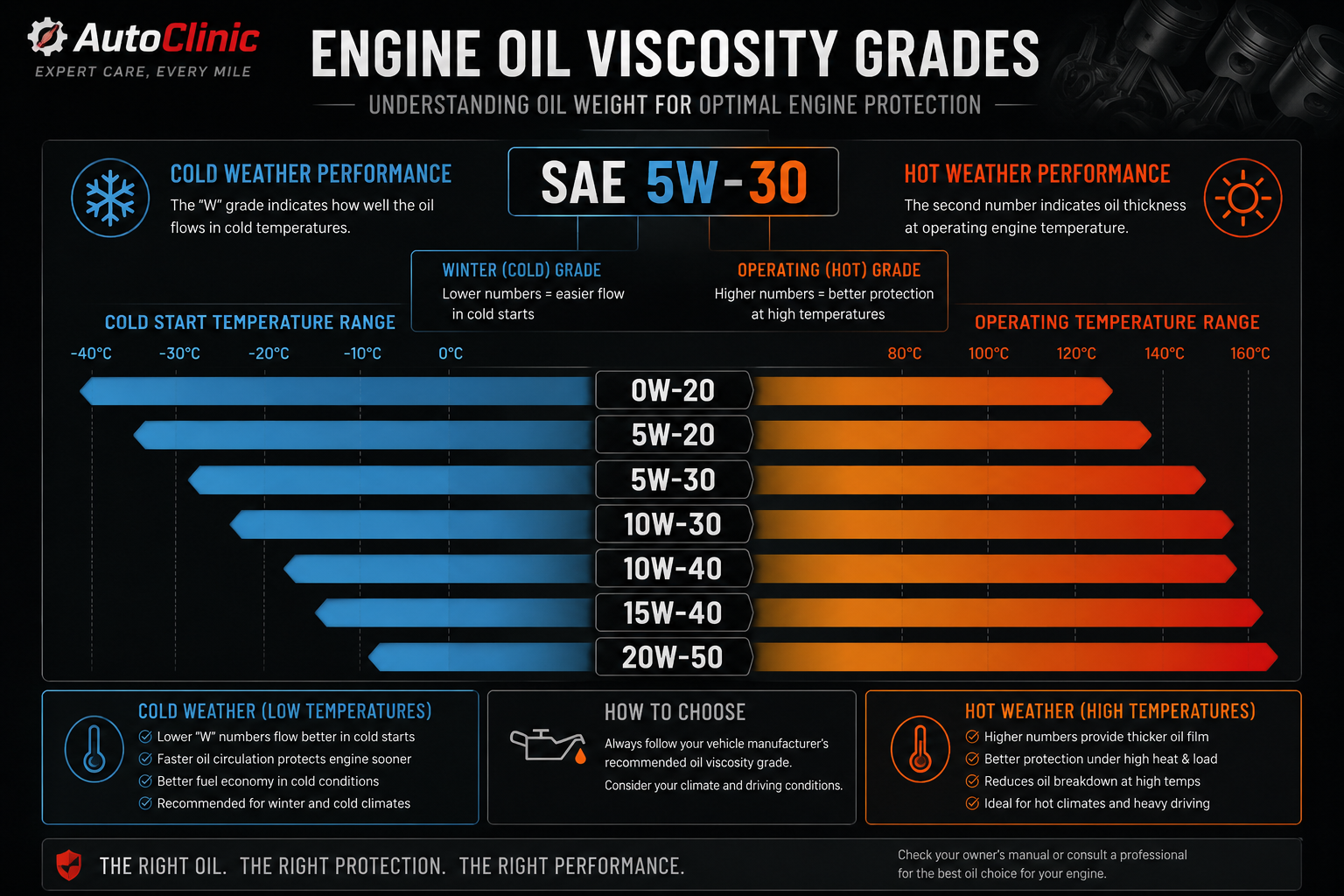
Engine
How Your Car's Lubrication System Works — Oil, Pump, Filter and More
August 27, 2026 5 min readEngine
Engine oil is the lifeblood of your car. Here is how the entire lubrication system works, what each component does, and what happens when any part of it fails.
Written by
Car Guide CrewThe Car Guide Crew editorial team publishes practical, mechanic-verified automotive knowledge — helping drivers understand, diagnose, and maintain their vehicles.
DiagnosticsEngine SystemsMaintenanceElectrical Systems
Published: Aug 27, 2026
What the Lubrication System Does
Engine oil performs five critical jobs simultaneously:
- Lubrication — creates a thin film between moving metal surfaces preventing direct metal-to-metal contact
- Cooling — carries heat away from engine components that the coolant cannot reach, particularly pistons and bearings
- Cleaning — suspends dirt, carbon, and combustion byproducts and carries them to the oil filter
- Sealing — helps piston rings seal against cylinder walls improving compression
- Protection — contains additives that prevent corrosion and oxidation of internal engine surfaces
When the lubrication system fails — whether from low oil level, oil pump failure, or severely degraded oil — engine damage begins almost immediately. Some failures cause complete engine seizure within seconds. This is why the oil pressure warning light is the most urgent warning light on any dashboard.
How Oil Flows Through the Engine
The lubrication system is a pressurized circuit that runs continuously while the engine operates. Understanding the flow path helps you understand what happens when any component fails:
- Oil sits in the sump at the bottom of the engine when at rest
- When the engine starts the oil pump draws oil from the sump through the pickup tube and filter screen
- The pump pressurizes the oil and pushes it through the oil filter
- Filtered oil enters the main oil gallery — a passage running the length of the engine block
- Oil branches from the main gallery to the crankshaft main bearings
- Oil travels through passages in the crankshaft to the connecting rod bearings
- Oil is also directed upward to the cylinder head to lubricate the camshaft, rocker arms, and valve train
- Oil splashes onto cylinder walls and piston pins during operation
- Gravity returns all oil back down to the sump to repeat the cycle
The Main Components of the Lubrication System
1. Oil Sump (Oil Pan)
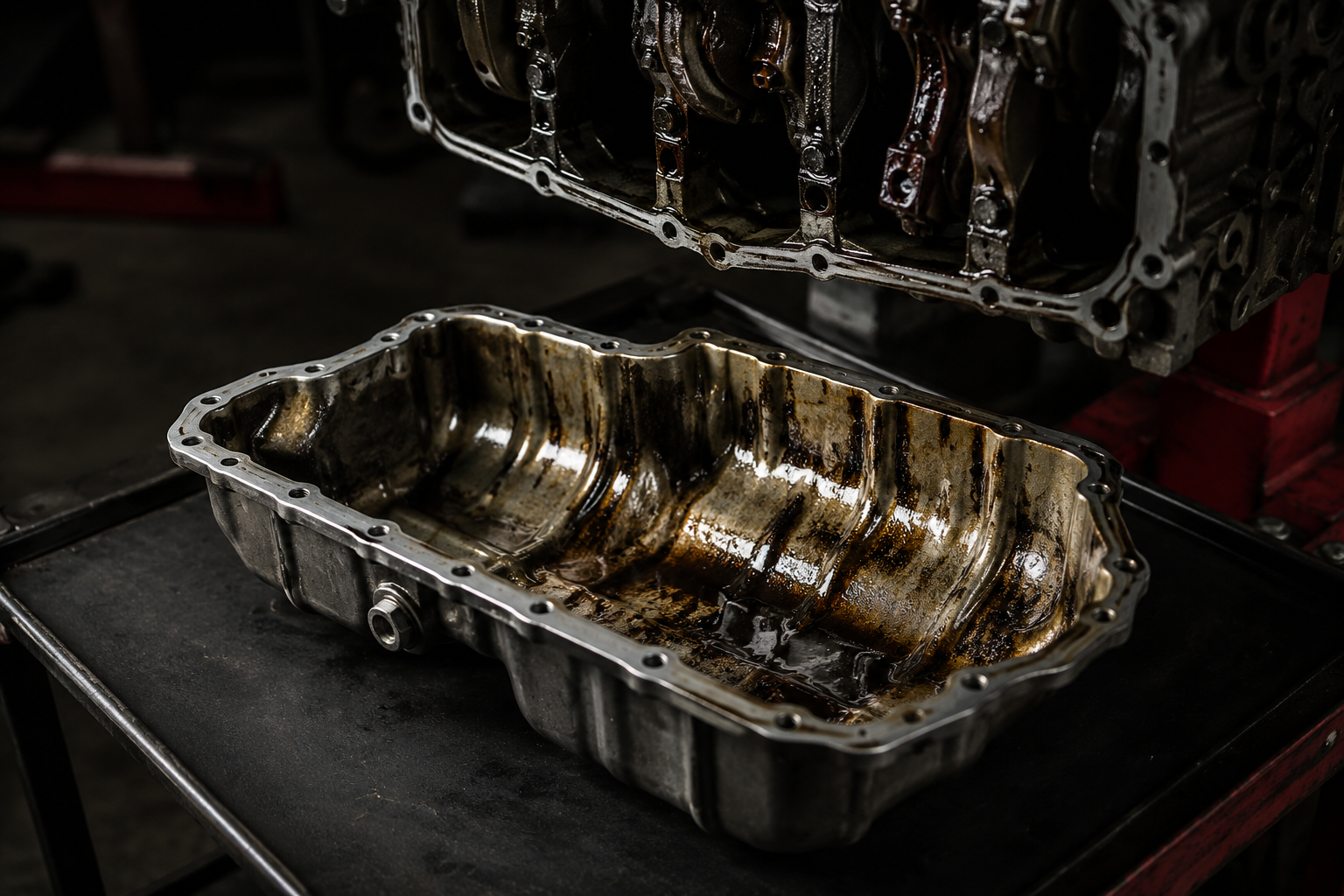
The oil sump is the reservoir at the bottom of the engine that holds the bulk of the engine oil supply. It is bolted to the bottom of the engine block and sealed with a gasket. The drain plug at the bottom allows oil to be drained during an oil change.
Inside the sump sits the oil pickup tube — a pipe with a fine mesh screen at its end that draws oil into the pump. This screen is the first stage of filtration, catching large particles before they reach the pump.
Common sump problems:
- Drain plug leak — stripped threads or damaged washer allows oil to seep out
- Sump gasket leak — gasket deteriorates over time causing slow oil loss
- Impact damage — low-hanging sumps on some vehicles crack from road debris or speed bumps
- Pickup tube blockage — sludge from neglected oil changes blocks the screen starving the pump of oil
A blocked oil pickup screen is a catastrophic failure that happens silently. The oil level may appear correct on the dipstick but the pump cannot draw oil through the blocked screen. Oil pressure drops to zero and the engine destroys itself within seconds of startup. This is caused entirely by skipping oil changes — sludge that builds up from old oil eventually blocks the screen completely.
2. Oil Pump
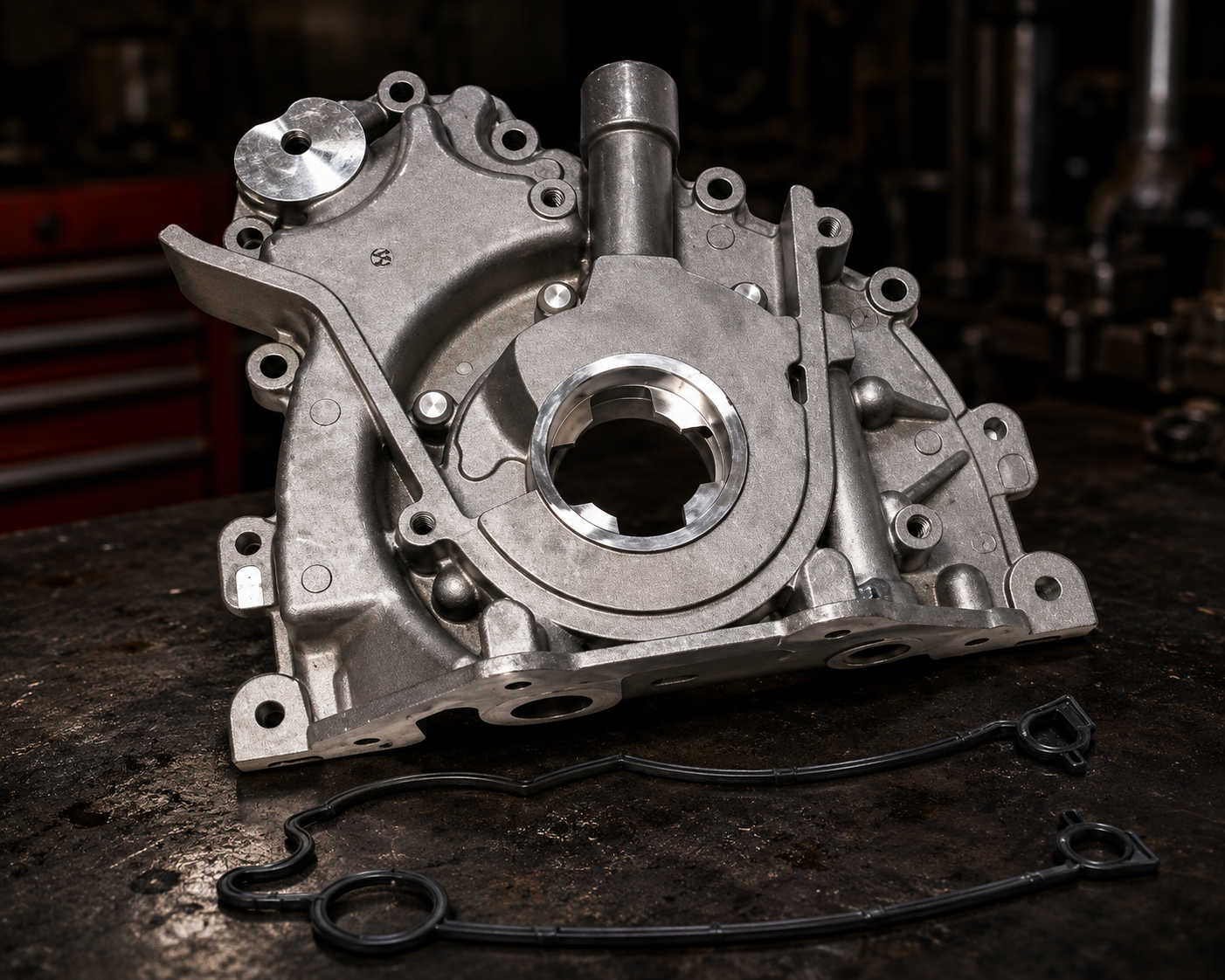
The oil pump is the heart of the lubrication system. It is a positive displacement pump — meaning it moves a fixed volume of oil with each rotation — driven directly by the engine via the crankshaft or a dedicated drive shaft. On most modern engines the oil pump sits inside the front of the engine or in the sump itself.
The pump creates the oil pressure that forces oil to every bearing surface in the engine. Without adequate pump pressure, oil cannot reach the upper parts of the engine — the camshaft and valve train — which are the first to suffer damage when pressure drops.
Symptoms of a failing oil pump:
- Oil pressure warning light illuminates — most critical symptom
- Low oil pressure reading on oil pressure gauge
- Ticking or clattering noise from the valve train — top of engine not receiving oil
- Engine overheating — oil not cooling internal components
- Increased engine wear visible in oil analysis
Oil pump failure is relatively rare on well-maintained engines — the pump is a robust component. When oil pumps fail prematurely it is almost always due to oil starvation from low oil level, running the engine with no oil, or severe sludge buildup blocking the pickup screen. Maintaining correct oil level and changing oil on schedule is the complete prevention strategy for oil pump failure.
3. Oil Filter
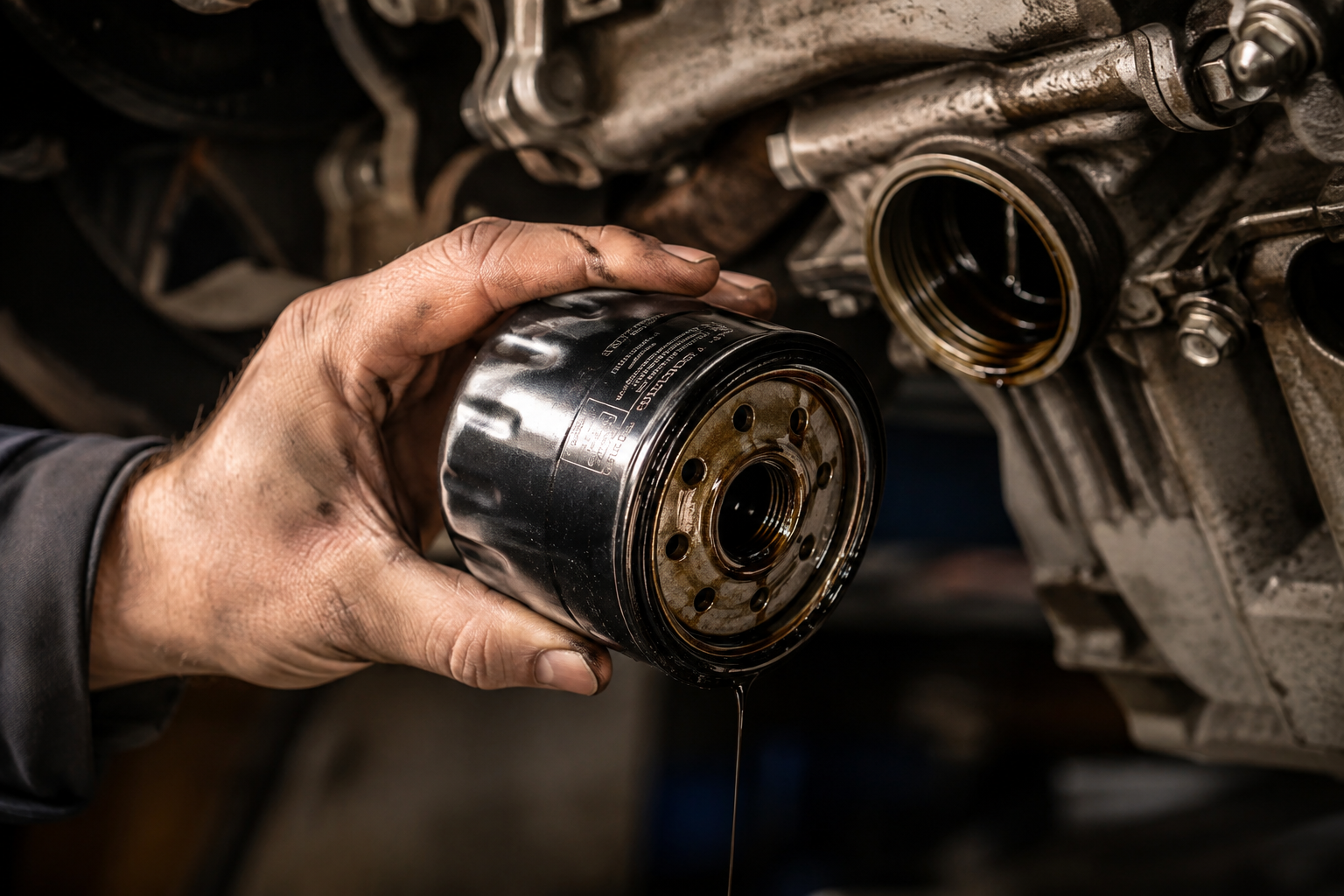
The oil filter removes metal particles, carbon deposits, dirt, and combustion byproducts from the oil before it circulates through the engine. A quality oil filter contains pleated filter paper with extremely fine pores that trap particles as small as 25 microns — about a quarter the diameter of a human hair.
Every oil filter contains a bypass valve — a spring-loaded valve that opens if the filter becomes severely clogged. This allows unfiltered oil to continue flowing rather than starving the engine of pressure. While this protects the engine from immediate seizure, it means dirty unfiltered oil is circulating — accelerating wear on all bearing surfaces.
Oil filter facts every driver should know:
- Always replace the oil filter with every oil change — a full oil change with an old filter is only partially effective
- Cheap oil filters use lower quality filter media that allows more particles through
- The filter holds approximately 0.3–0.5 litres of oil — when you drain oil without changing the filter you are mixing new oil with this old contaminated reserve
- Quality brands like Toyota Genuine, NGK, Denso, Mann, and Bosch use higher quality filter media than unbranded alternatives
4. Oil Pressure Relief Valve
The pressure relief valve is a spring-loaded valve that limits maximum oil pressure in the system. At cold start, oil is thick and the pump generates very high pressure — the relief valve opens to divert excess oil back to the sump preventing damage to seals, gaskets, and the filter. As the engine warms and oil thins, the valve closes and normal operating pressure is maintained.
A stuck-open relief valve causes chronically low oil pressure. A stuck-closed valve can cause dangerously high pressure that blows oil seals and gaskets.
5. Oil Cooler
Many engines — particularly turbocharged, diesel, and performance engines — use an oil cooler to maintain oil temperature within the ideal operating range. Oil that runs too hot loses its viscosity and lubricating properties. An oil cooler is either:
- Air-cooled — a small radiator-style unit mounted in the airflow at the front of the engine bay
- Water-cooled — a heat exchanger where engine coolant absorbs heat from the oil. Common on modern turbocharged engines
Oil cooler problems:
- External leaks — seals and gaskets fail causing oil or coolant leaks
- Internal failure — coolant mixes with oil. Milky oil on the dipstick is the classic symptom
- Blockage — restricted flow causes oil to run hot
Engine Oil — Types, Grades and What They Mean
Oil Types
| Type | What It Is | Best For |
|---|---|---|
| Conventional (Mineral) | Refined from crude oil with basic additive package | Older engines, low-stress applications, budget maintenance |
| Semi-Synthetic | Blend of conventional and synthetic base oils | Most standard Japanese imports — good balance of protection and cost |
| Full Synthetic | Chemically engineered base oil with advanced additives | Modern engines, turbocharged engines, extreme temperature conditions, extended drain intervals |
| High Mileage | Synthetic or semi-synthetic with seal conditioners | Engines over 120,000 km — helps reduce oil consumption and seal leaks |
Understanding Oil Viscosity Grades
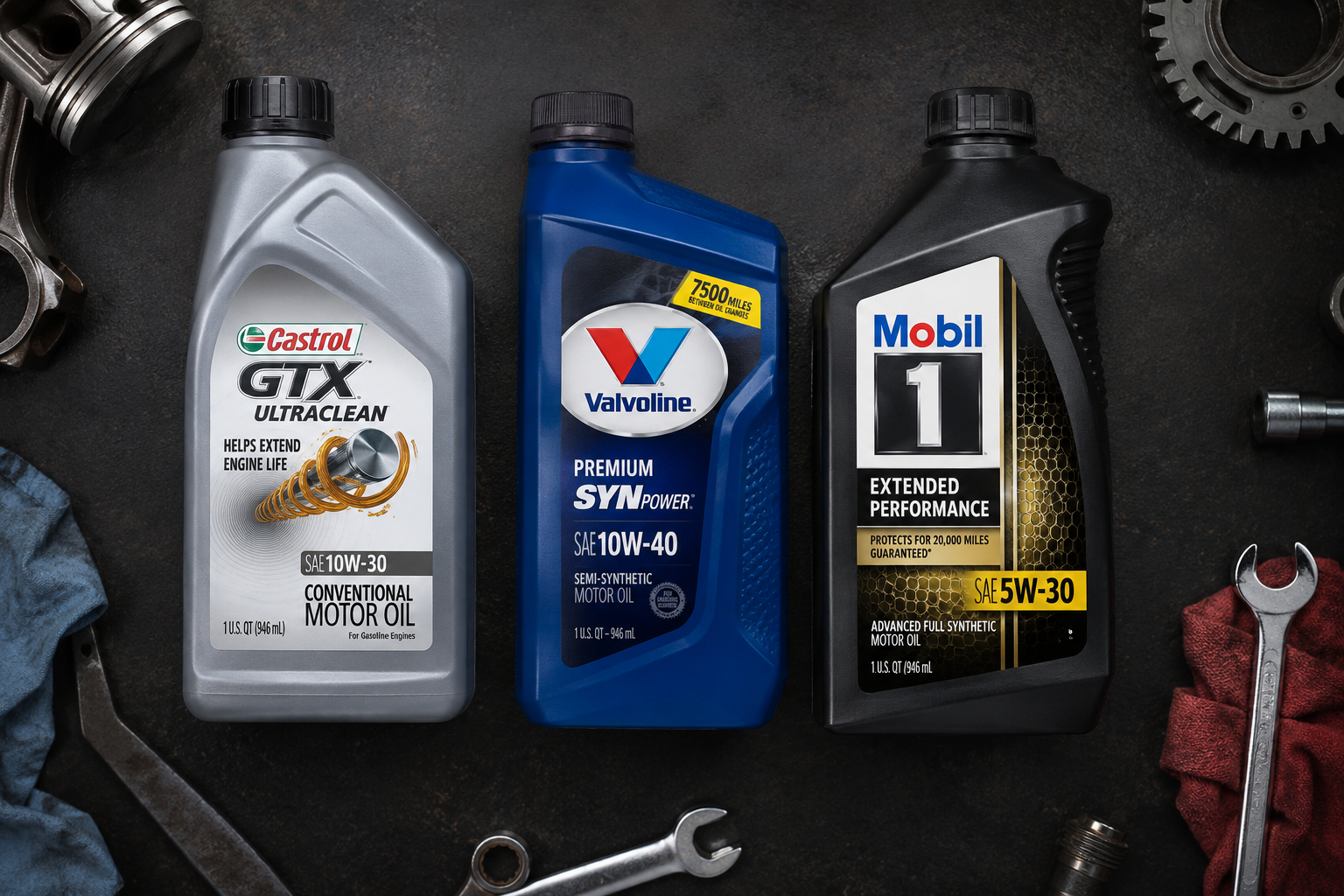
The viscosity grade on an oil bottle — such as 5W-30 or 10W-40 — tells you how the oil flows at different temperatures. Understanding this helps you choose the correct oil for your engine and climate.
The grade has two numbers separated by a W:
- The number before W — cold temperature viscosity. The W stands for Winter. A lower number means the oil flows better in cold conditions. 0W flows better when cold than 10W
- The number after W — hot temperature viscosity at operating temperature. A higher number means the oil is thicker when hot. 40 is thicker at operating temperature than 30
| Grade | Cold Flow | Hot Viscosity | Common Applications |
|---|---|---|---|
| 0W-20 | Excellent | Very thin | Modern fuel-efficient Toyota, Honda engines |
| 5W-30 | Very good | Medium | Most Japanese imports — Toyota, Honda, Subaru |
| 5W-40 | Very good | Thicker | Turbocharged engines, performance applications |
| 10W-30 | Good | Medium | Older naturally aspirated engines |
| 10W-40 | Good | Thicker | High mileage engines, hot climates |
| 15W-40 | Moderate | Thick | Diesel engines, older high-mileage engines |
Always use the oil viscosity specified in your owner's manual — not what the parts shop recommends or what was cheapest. Using oil that is too thick reduces fuel economy and puts strain on the oil pump at cold start. Using oil that is too thin reduces film strength at operating temperature accelerating bearing wear. The manufacturer specification exists for a reason.
How To Check Your Engine Oil
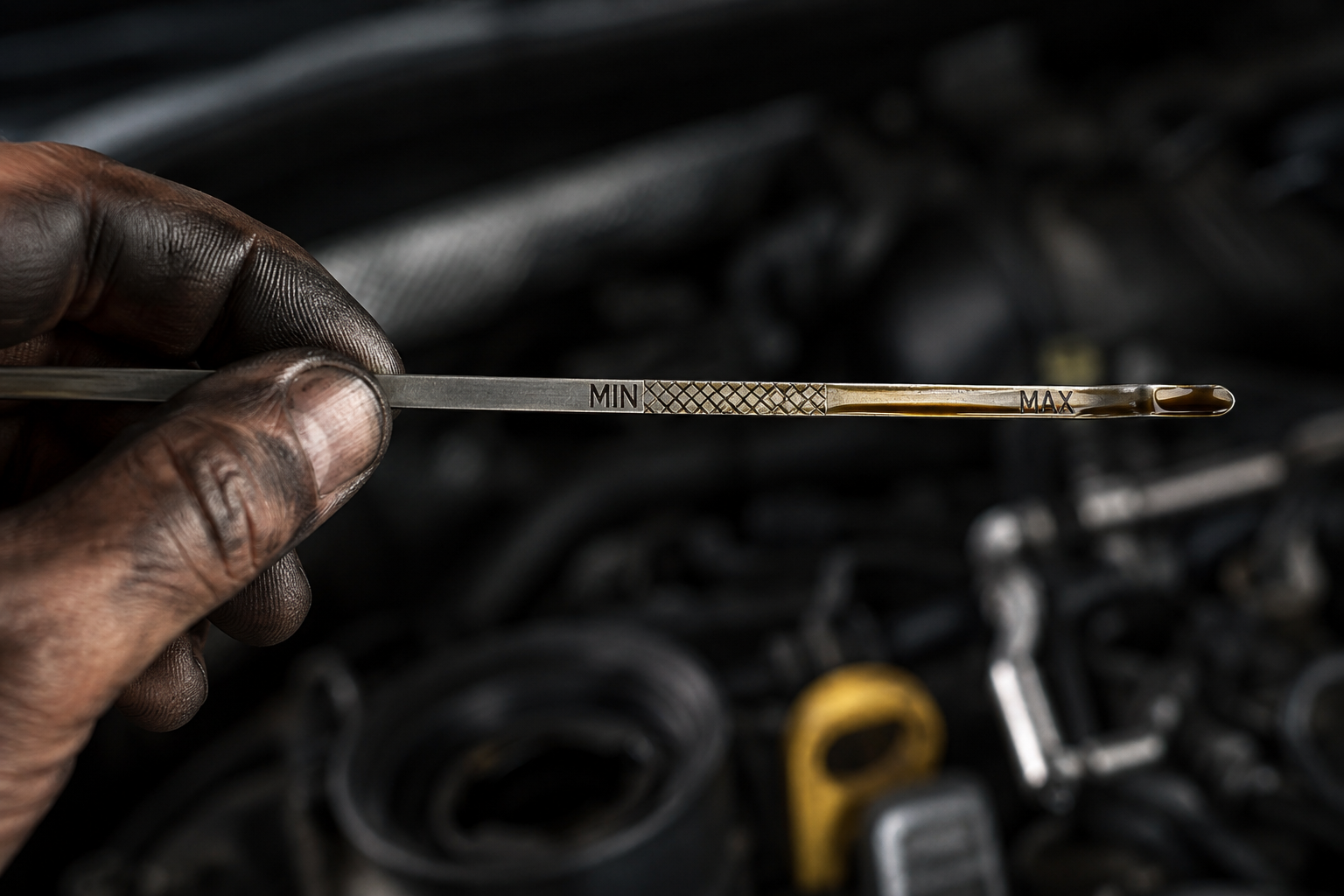
Checking engine oil takes less than 2 minutes and should be done at least once a month. Always check with the engine cold or after it has been sitting for at least 5 minutes so oil has drained back into the sump:
- Park on a level surface — a sloped surface gives a false reading
- Open the bonnet and locate the oil dipstick — usually has a yellow or orange handle
- Pull the dipstick out fully and wipe it clean with a cloth
- Reinsert the dipstick fully until it seats
- Pull it out again and read the oil level against the MIN and MAX marks
- The oil should be between MIN and MAX — ideally closer to MAX
- Also check the oil condition — rub a small amount between your fingers
What the oil tells you:
- Golden or light brown, slightly transparent — fresh or recently changed oil in good condition
- Dark brown, opaque but not gritty — used oil due for a change soon
- Black and gritty — overdue for a change, contains carbon and metal particles
- Milky, creamy, or frothy — coolant contamination. Stop driving immediately — head gasket failure or cracked block
- Smells of petrol — fuel contamination from a stuck-open injector or failed piston rings
Common Lubrication System Problems
| Symptom | Most Likely Cause | Urgency |
|---|---|---|
| Oil pressure warning light on | Low oil level, failed pump, blocked pickup screen | Very High — stop immediately |
| Ticking noise from engine top | Low oil pressure to valve train, dirty oil | High — check oil immediately |
| Oil level dropping between changes | Oil leak or internal oil consumption | High — find source |
| Blue smoke from exhaust | Oil burning — worn rings or valve seals | High |
| Milky oil on dipstick | Coolant in oil — head gasket failure | Very High — stop driving |
| Oil leak under car | Gasket, seal, or drain plug leak | High — fix before level drops |
| Dark black oil immediately after change | Internal sludge contaminating new oil | Medium — engine flush needed |
| Knocking from lower engine | Bearing wear from oil starvation | Very High — stop driving |
Oil Change Intervals — What Is Actually Correct
| Oil Type | Standard Interval | Severe Use Interval |
|---|---|---|
| Conventional mineral oil | Every 5,000 km or 6 months | Every 3,000 km |
| Semi-synthetic oil | Every 7,500–10,000 km or 6 months | Every 5,000 km |
| Full synthetic oil | Every 10,000–15,000 km or 12 months | Every 7,500 km |
Severe use conditions that require shorter intervals:
- Predominantly short trips under 10 km — engine never fully warms up, moisture accumulates in oil
- Dusty driving conditions — more contaminants enter through the air intake
- Towing or heavy loads regularly
- Taxi, matatu, or high-mileage commercial use
- Engine with known oil consumption — check level more frequently
Estimated Costs
| Service or Repair | Estimated Cost |
|---|---|
| Oil and filter change (conventional) | $30–$60 |
| Oil and filter change (synthetic) | $60–$120 |
| Oil drain plug replacement | $10–$30 |
| Oil pan gasket replacement | $100–$300 |
| Oil pump replacement | $300–$800 |
| Oil cooler replacement | $200–$600 |
| Engine flush service | $60–$150 |
| Valve cover gasket (oil leak) | $100–$400 |
| Rear main seal replacement | $300–$800 |
| Engine rebuild from oil neglect | $2,000–$6,000 |
How To Keep Your Lubrication System Healthy
- Check oil level monthly — do not wait for the warning light
- Change oil and filter on schedule — this is the single most important maintenance task on any engine
- Use the correct oil grade specified in your owner's manual
- Use quality oil from reputable brands — cheap oil has inferior additive packages that break down faster
- Never ignore an oil pressure warning light — stop the engine immediately and investigate
- Fix oil leaks promptly — a slow drip becomes a serious leak and an empty sump over time
- Warm up the engine gently for the first minute after cold start — oil needs time to reach all surfaces before high RPM driving
- Avoid idling for extended periods — prolonged idling generates combustion byproducts that contaminate oil faster than highway driving
FAQ
How much oil loss between changes is normal? A well-maintained engine in good condition should consume almost no oil between changes. Losing more than 0.5 litres per 1,000 km is considered excessive and warrants investigation. High mileage engines (over 150,000 km) may consume slightly more — up to 1 litre per 5,000 km is generally acceptable but should be monitored.
Can I top up with a different brand of oil than what is in the engine? Yes for top-ups in an emergency — mixing oil brands of the same viscosity and type is acceptable short-term. Avoid mixing conventional and full synthetic if possible. At the next oil change drain and refill with a consistent single product.
My oil turns black very quickly after a change — is that normal? Oil darkens as it does its job — suspending combustion byproducts and carbon. Oil turning dark after a few thousand kilometres is normal and indicates the oil is working correctly. Oil turning black within 500–1,000 km of a change suggests significant internal contamination — an engine flush and investigation of combustion health may be needed.
Is it safe to drive with the oil light on briefly at startup? On some older engines a brief flicker of the oil light at cold startup — lasting less than a second — is normal as pressure builds. If the light stays on for more than 1–2 seconds after startup, or comes on while driving, stop the engine immediately. Do not risk driving further — oil pressure loss causes irreversible bearing damage within seconds.
What is an engine flush and should I use one? An engine flush is a cleaning solvent added to old oil before draining that dissolves sludge and deposits. It can be beneficial on a high mileage engine with a history of neglected oil changes. However on a severely sludged engine a flush can dislodge large deposits that then block oil passages — causing the exact oil starvation it was meant to prevent. Consult a mechanic before using a flush on an engine with unknown service history.
More From Engine
 Engine
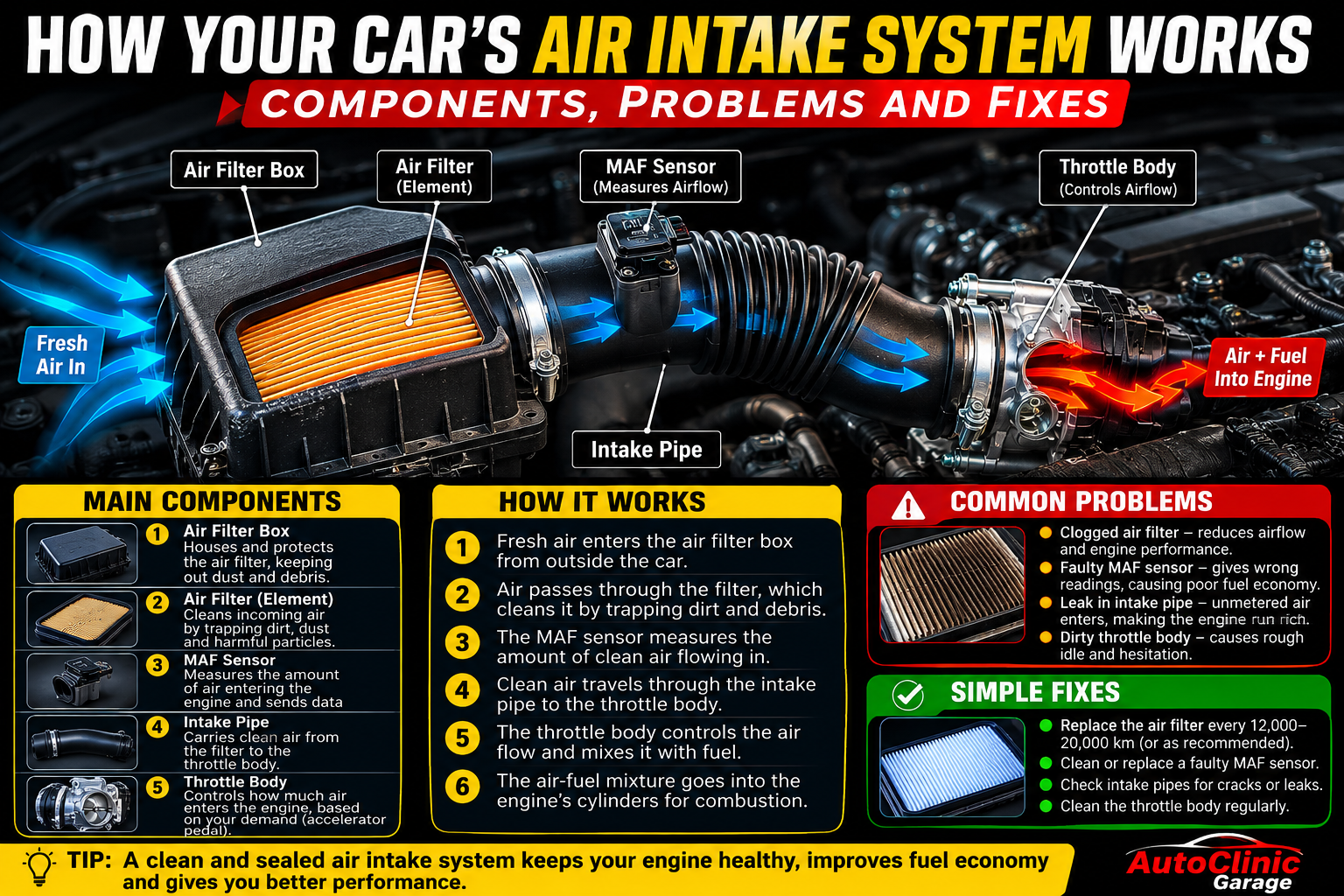
How Your Car's Air Intake System Works — Components, Problems and Fixes
Your engine needs clean measured air to run efficiently. Here is how every part of the air intake system works and what happens when any one of them fails.
Aug 26, 2026 5 min
Read more 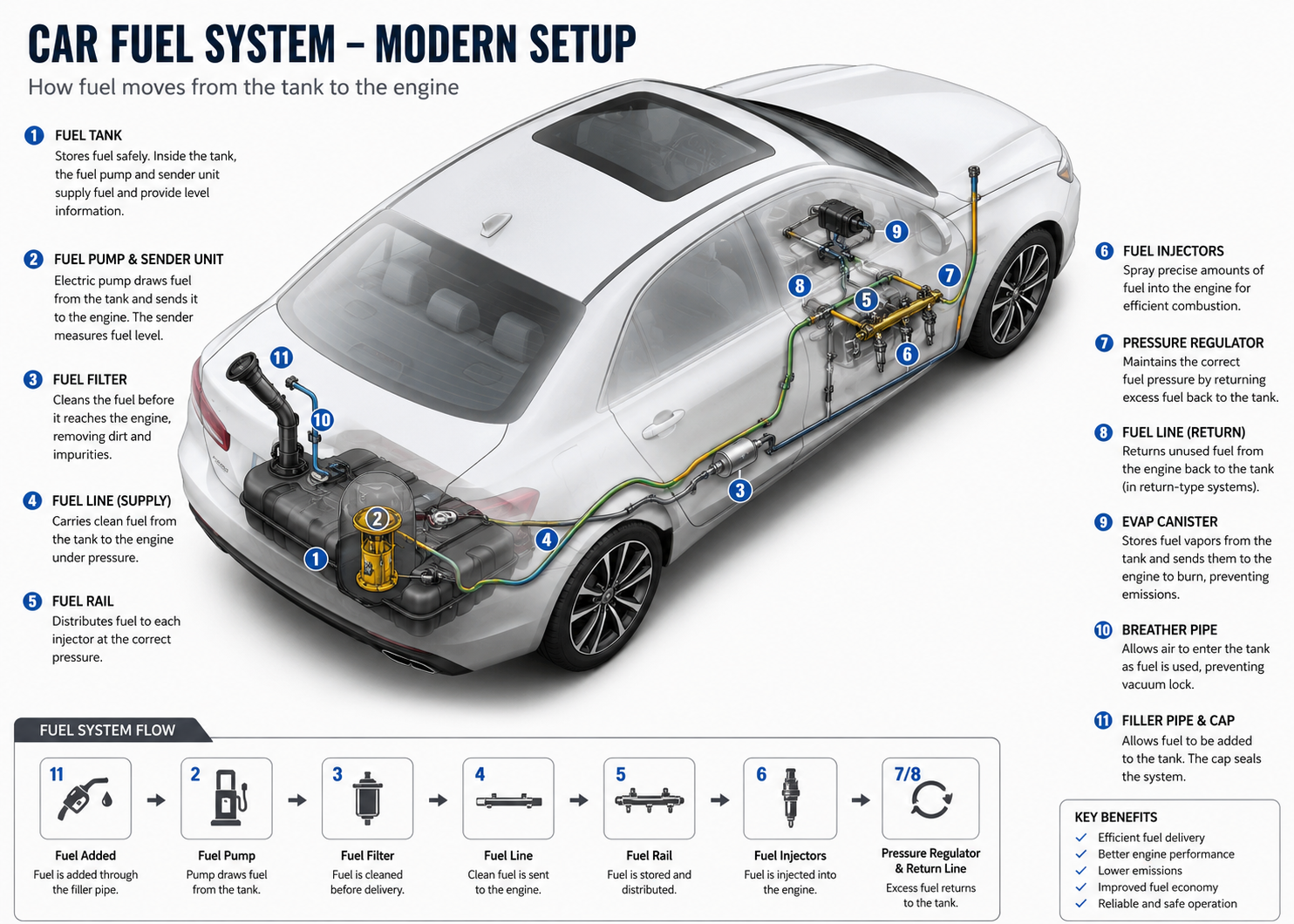 Engine
How Your Car's Fuel System Works — Components, Problems and Fixes
Your fuel system delivers clean fuel at the right pressure to keep your engine running. Here is how every component works and what happens when any one of them fails
Aug 25, 2026 5 min
Read more  Engine
How a Car Radiator Works — and What Goes Wrong
Your radiator keeps your engine from destroying itself. Here is how it works, what goes wrong, and how to maintain it before it causes an expensive breakdown.
Aug 20, 2026 5 min
Read more